A university application CV should be no longer than two sides of A4. Learning how to write a CV for university applications means making every section earn its space, not squeezing in every detail from your academic and work history. The strongest examples make relevant qualifications, research and experience easy to find.
It’s understandable to focus first on page count when you’re unsure whether to include a thesis, references, or activities beyond your studies. Length matters, but a clear structure and relevant details help admissions readers understand your preparation and potential.
This guide explains how to choose and arrange sections, present your education and thesis, handle references, and use examples to shape your own CV. You’ll get a practical framework for creating a concise application document that reflects your academic strengths.
Key Takeaways
- Keep a university application CV to two sides of A4, use clear formatting, and prioritise relevant academic evidence.
- Make education entries easy to scan with qualifications, institutions, completion dates, and relevant thesis details.
- Choose references who can speak to your academic strengths, and present their details in a consistent final section.
- Use academic CV examples to guide section choices, then adapt the content to your application rather than copying a template.
- Distinguish an academic CV from a resume by the purpose of the application and the evidence it needs to show.
Academic CV formatting and length
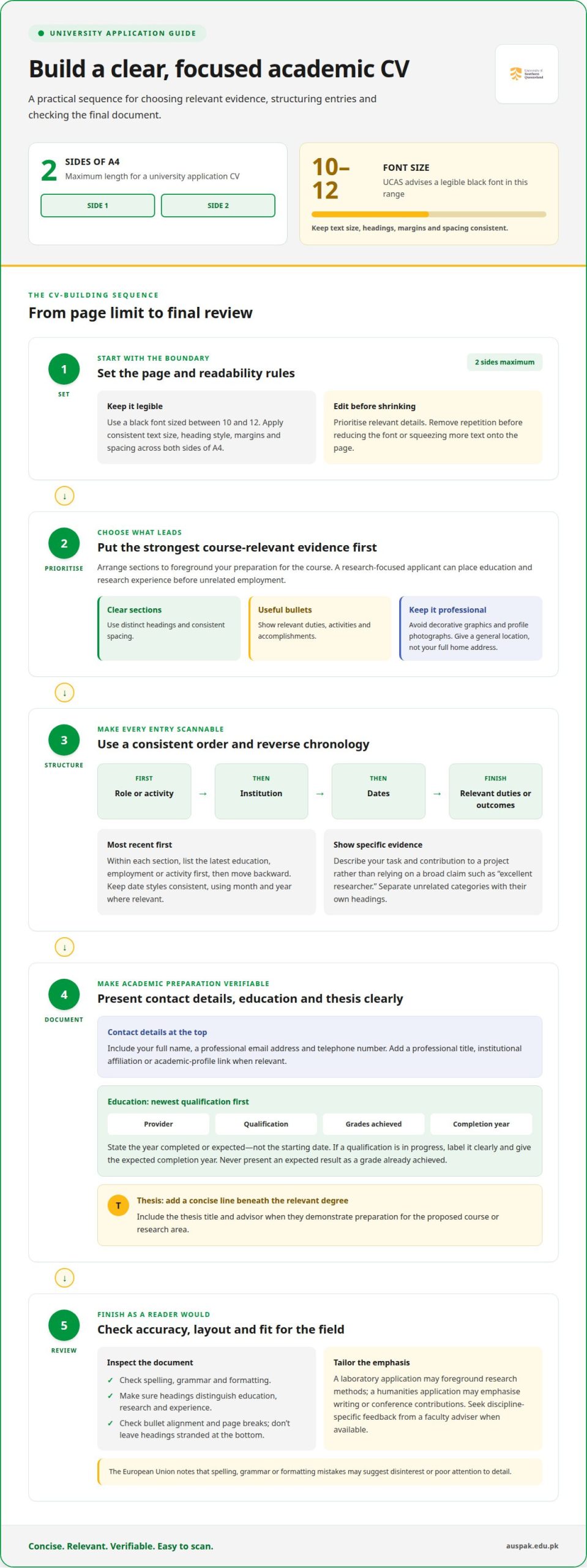
Keep a university application CV to no more than two sides of A4. A practical approach to how to write a CV for university applications starts with a clear layout that makes academic evidence easy to find.
Choose a clear CV layout
Arrange sections to foreground your strongest evidence for the course. A research-focused applicant, for example, can place education and research experience before unrelated employment. Use distinct headings and consistent spacing, and list entries within each category in reverse chronological order, with the most recent first.
Use bullet points for relevant duties, activities, and accomplishments. A research assistant entry, for instance, can separate laboratory responsibilities from a conference presentation. Avoid dense paragraphs, decorative graphics, and a profile photograph; a university application CV doesn’t need images. Give a general location rather than your full home address.
Set formatting and length
Set the document in a legible black font sized between 10 and 12, as UCAS advises. Keep text size, heading style, margins, and spacing consistent across both sides of A4. As you decide how to write a CV for university applications, prioritise relevant details over crowded pages. Remove repetition before shrinking the font or squeezing in more text.
Use the two-page limit as an editing guide for a university application CV. A resume follows different conventions: the United Nations Office of Human Resources Management (OHRM) says a resume should be one page if possible, and two only when relevant work experience requires it. Don’t automatically apply that resume rule to an academic CV.
- Build each section around concise, specific evidence. For example, describe your task and contribution to a research project instead of making a broad claim such as “excellent researcher.” Make entries easy to scan with a clear sequence: role or activity, institution, dates, then relevant responsibilities or outcomes. Tailor the detail to the application.
Chronology helps readers follow your development without searching through mixed dates. Put the most recent education, employment, or activity first within its section, then move backward. Keep date styles consistent, using month and year where relevant. Don’t combine unrelated categories into one timeline when separate headings make your experience clearer.
- Review the finished document as a reader would. Check that headings distinguish education, research, and experience, and that bullet points align consistently. Read each entry for spelling and grammar, then inspect page breaks so headings aren’t stranded at the bottom. The European Union notes that spelling, grammar, or formatting mistakes may suggest disinterest or poor attention to detail.
Finally, compare your completed CV with conventions in your academic field. A laboratory application may foreground research methods, while a humanities application may emphasise writing or conference contributions. Ask a faculty adviser for discipline-specific feedback when available. Keep the final version readable and focused on evidence relevant to the university application.
Education details and thesis information
Build this section around verifiable academic details, then add contact information that allows an admissions reader to reach you directly.
- Place your contact details at the top of the CV. Include your full name, a professional email address, and telephone number so readers can identify and contact you. If relevant, add a professional title, institutional affiliation, and links to academic profiles. For example, a current student might list their name, degree programme, university, email, and phone number together.
Choose an email address that looks suitable for an application and is easy to read. Add a professional profile link only when it supports your academic background, such as a page listing research publications. Keep contact details separate from education entries so readers can find both without confusing your current affiliation with a qualification.
- List formal education in reverse chronological order, beginning with your current or most recent qualification. Include your education provider, qualification, and grades achieved. For an academic CV, show the year of completion or expected completion, rather than the starting date. For example, write “BS Biology, University of Karachi, expected completion 2027” if that accurately describes your programme.
Include formal education back to secondary school when the application calls for a full education history. Give each qualification its own entry so readers can distinguish secondary education from undergraduate study. If you’re still studying, label the qualification as in progress and state the expected completion year. Never present an expected result as a grade already achieved.
- Make each education entry informative without turning it into a transcript. State the degree type, major, minor, department, and institution where they help explain your preparation. Add honours or awards related to the qualification. For example, a chemistry graduate could list a chemistry major, the relevant department, and a departmental award earned during study.
Use the same order of details for every qualification. Readers should be able to scan the institution, programme, completion year, and achieved grades without interpreting a different format each time. Include grades when available and relevant to the application. Put unrelated school activities in another section rather than crowding the education record.
- Give thesis information its own concise line beneath the relevant degree. Include the thesis title and advisor when these details demonstrate preparation for the proposed course or research area. For example: “Thesis: Water quality in urban wetlands; advisor: Dr. Amina Khan.” Use the official title, then add a brief description only if the title alone doesn’t make the subject clear.
Connect the thesis to your academic direction through specific subject matter, methods, or findings, not unsupported claims. A biology applicant might mention field sampling or data analysis if these were genuine parts of the project. Keep the explanation distinct from the title and advisor, and avoid lengthy abstracts. This gives readers a clear view of your research experience while preserving space for other relevant qualifications.
References and sample CV sections
Use references, skills, and sample entries to make your academic evidence specific and easy to assess.
Include references
Add a references section at the end of the CV, listing 3-5 professional or academic referees who can speak to your qualifications. Choose people familiar with your academic work, research ability, or relevant experience. Give each referee’s name, professional title, institution, and contact details when the application requests them.
If you’re not ready to share contact details, state “References available on request.” You can provide referee information later. Keep the wording consistent, and don’t list anyone without their agreement. A lecturer who supervised your research, for example, may be able to comment on your analytical work more directly than a referee who knows only your name.
Add a core skills section
Create a concise skills section using 2-3 columns of bullet points. Include abilities relevant to the course or research opportunity, such as laboratory techniques, statistical analysis, academic writing, or language proficiency. Use accurate proficiency labels, such as intermediate, advanced, fully proficient, or native fluency, rather than broad claims like “excellent communication.”
Make each skill easy to substantiate elsewhere in the CV. If you list data analysis, connect it to a research project or presentation in another section. Avoid filling columns with generic traits that don’t distinguish your preparation. A concise list of relevant methods and tools gives readers clearer evidence than a long inventory of unsupported strengths.
- Use sample CV sections as models for structure, not as claims to copy. A work entry can pair a role with a clear achievement; for example, a sample reports that supply ordering based on daily demand reduced waste by 50%. Treat that figure as an illustration only. Replace it with an outcome you can accurately explain and substantiate.
Other sample entries show how to select detail for different fields. One pharmacist entry describes maintaining a dispensing database of over 100,000 clients, while a teacher example describes curriculum design for 17 adults. These examples demonstrate measurable scope, but your own evidence may instead name a research method, academic contribution, or project outcome.
- Separate academic outputs into categories readers can interpret quickly. List published works separately from conference papers and presentations. For publications, use this order: books, book chapters, peer-reviewed journal articles, then contributions to edited volumes equivalent to peer-reviewed journals. This sequence distinguishes publication types without making readers infer their status.
Keep conference activity clear, too. An academic CV can distinguish invited conference talks, campus talks, and conference participation without a lecture. For example, label a presentation as an invited talk when that accurately describes it. A sample research entry may show how work led to two conference presentations and one peer-reviewed publication, but include only outputs you actually completed.
Academic CV versus resume
Choose the document that matches the opportunity, because an academic CV and a resume present experience differently. Use the format requested in the application as your starting point.
- Identify whether the opportunity is academic, scientific, research-based, or non-academic. CVs are used for academic, scientific, and research positions, while most employers in industry prefer a resume. For example, a university research role calls for evidence of academic preparation, while an industry job application generally benefits from a focused resume.
Read the application instructions before adapting your document. If a university asks for a CV, don’t replace it with a resume simply because you’re more familiar with that format. The document’s purpose determines which details deserve space: a research application may need publications and presentations, while a non-academic employer may prioritise relevant work experience.
- Build an academic CV that shows the depth and development of your academic record. Include relevant education, research experience, publications, conference presentations, and academic appointments where applicable. For example, a postgraduate applicant could present a research assistant role, a peer-reviewed article, and a conference presentation as separate evidence of preparation.
Keep categories distinct so readers can assess each contribution. Published works belong apart from conference papers and presentations. For professional appointments, identify the institution, department, title, dates, and duties. A CV can range from two pages to several pages, depending on the applicant’s record and field. For a university application, focus the content on the opportunity.
- Shape a resume around experience relevant to a non-academic role. In the United States, resumes for non-academic positions are typically one or two pages long, and most employers use resumes for those roles. The United Nations Office of Human Resources Management (OHRM) advises keeping a resume to one page if possible, and using two only when relevant work experience needs the space.
For example, a laboratory graduate applying for a research post may need methods, publications, and presentations to be easy to find. The same graduate applying for a laboratory operations job could foreground relevant responsibilities and achievements instead. Adapt the emphasis to the role; don’t simply shorten the academic CV while leaving every section unchanged.
- Convert a CV into a resume by selecting evidence, not by shrinking the type or compressing every entry. Keep the experience most relevant to the target position, and remove academic details that don’t support the application. When converting a CV into a resume, don’t exceed two pages.
Use the same distinction when preparing separate applications. An academic application may call for a broader record, while an industry application needs a concise selection. For example, retain a research project if it demonstrates a method required for the role. Remove it if it adds detail without showing relevant preparation.
CV examples for university applicants
Use examples to see how academic evidence can be arranged, then adapt the structure to your own record. A sample should guide your choices, not provide claims to copy.
To tailor a CV to a university course, identify the programme’s academic focus and prioritise supporting evidence. A biology applicant could foreground relevant research methods, while a literature applicant might emphasise analytical writing or conference contributions.
For applications in Pakistan, follow the university’s and programme’s instructions, since required documents and formats can differ. A clear CV commonly presents contact details, education, relevant experience, skills, and references in distinct sections.
Avoid generic content, unsupported achievements, inconsistent dates, and spelling or formatting errors. Don’t copy another applicant’s figures or present expected grades, publications, or experience as completed facts.
Review university applicant CV examples
Compare examples from applicants at a similar academic stage, then note how each presents evidence. A school-leaver’s example may focus on qualifications, projects, and relevant activities; a postgraduate example may include research contributions and publications. Check that each section has a clear purpose, and don’t treat one person’s layout as a universal university requirement.
Study how sample entries turn activities into specific evidence. For instance, a sample CV reports an average seminar satisfaction score of 88%. Your entry should describe an outcome you can support, such as attendee feedback or a completed project, rather than borrowing that figure. Use examples to learn the level of detail, not to reproduce another applicant’s results.
Tailor the CV to the course or programme
Match your strongest evidence to the programme’s subject and stated selection criteria. UCAS advises tailoring a CV to the application rather than sending a generic version. For a research-focused course, foreground relevant projects and methods; for a course centred on practical work, give more space to applicable experience and demonstrated skills.
Keep the underlying facts accurate while changing their order and emphasis. If a programme highlights research, place a relevant project where it’s easy to find and explain your contribution precisely. Don’t add keywords or skills you can’t substantiate. A tailored CV connects your actual experience to the course without claiming experience you don’t have.
- Use a final review to test each example against your own record. Confirm that dates, grades, titles, and outcomes are accurate, and that each entry explains your contribution. A seminar example might state the topic, your role, and a documented result. Remove sample names, placeholder text, and achievements that belong to someone else.
- Match the submitted CV to the programme’s instructions before sending it. If an application requests particular sections or supporting details, organise the document accordingly. For Australian university applications, Australian University Admission Support can help with the broader application process alongside preparing your materials.
AusPak International: Australian University Admission Support
AusPak International supports students pursuing Australian university admission with counselling and application processing. Turn to the team when you’re ready to move from preparing your CV to shaping your wider application for study in Australia.
Your CV is one part of an application. The next step is aligning your academic profile and supporting materials with the programme you’re applying to. AusPak International’s Australian University Admission Support can guide you through that process. If your plans involve the UK or Canada instead, the team also provides UK Student Visa Consultancy and Canada Study Permit Assistance.
For guidance with your Australian university application, contact AusPak International.
Move from a Draft to Your Next Application Step
A clear CV can communicate your preparation, but the next step is connecting it to a complete university application. As you decide where to apply, align your course choice, supporting materials, and application timeline. A focused approach to how to write a CV for university applications gives you a practical starting point, while thoughtful planning helps carry that work into the application itself.
AusPak International offers Australian University Admission Support, UK Student Visa Consultancy, and Canada Study Permit Assistance for students planning study abroad. Choose support that fits your intended destination and the stage you’ve reached. For an application that needs guidance beyond the CV, contact AusPak International today.
Take the next step with a well-prepared application and a clear direction for your studies.
Frequently Asked Questions
How long should a CV be?
Length depends on the CV’s purpose and the experience it needs to present. Academic CVs can run from two pages to several pages, while a university application CV should be no longer than two sides of A4. For example, focus on qualifications and relevant evidence rather than adding unrelated activities just to fill space. If a programme provides its own instructions, use those to shape your final document.
What to include in your University Applicant CV profile?
Write a short profile of 3-5 lines that identifies your academic focus and strongest relevant preparation. For example, a prospective biology student might mention a biology qualification, a research project, and a relevant laboratory skill. Keep each claim factual and supported elsewhere in the CV. Avoid broad career aims in the profile; use a cover letter to explain longer-term objectives or why you want a particular programme.
What’s the difference between a CV and a resume?
A CV presents academic, scientific, or research experience, while a resume is generally a focused document for non-academic employment. An academic CV can include scholarly work and presentations; a resume selects experience relevant to a particular job. For example, a research applicant may need to show academic outputs, while someone applying for an industry role may prioritise practical responsibilities and achievements.
What should a CV for a university application include?
Include contact details, education, relevant work or research experience, skills, and any academic outputs that strengthen your application. Add thesis details, awards, activities, or references when they support your preparation and fit the programme. For example, an applicant for a research course could include a relevant project and its methods. Keep sections focused, and leave out personal details or achievements that don’t explain your academic readiness.
How should I format and structure an academic CV for university admissions?
Use clear section headings and arrange entries within each category from most recent to earliest. Present information consistently, with concise bullet points for responsibilities and accomplishments. Readers should be able to distinguish education, research, and work experience at a glance. Avoid photographs and decorative images, which aren’t needed for a university application CV. Before submitting, review the document for spelling, grammar, and consistent formatting.
How long should a university application CV be?
Keep a university application CV within two sides of A4. Treat that as a limit, not a target to fill: include details that show relevant academic preparation and remove material that doesn’t support the application. If the page feels crowded, edit repetitive descriptions before reducing text size. A concise document makes it easier to locate your most relevant evidence without asking the reader to search through unrelated information.
How do I write a personal profile or objective for a university CV?
Use a brief personal profile to describe your academic focus, preparation, and relevant strengths. Keep it to 3-5 lines and support each claim with evidence elsewhere in the CV. For instance, mention a research project if it relates to the intended programme. Don’t use the profile to state career objectives or goals; explain your motivation for applying in a cover letter instead.
How should I list education, grades, and academic achievements on a CV?
List education in reverse chronological order, including the institution, qualification, grades achieved, and completion year or expected completion year. A full formal education history may go back to secondary school. Add relevant honours or awards beneath the qualification they relate to. For an ongoing degree, label it as in progress and distinguish expected results from grades already awarded.