
Imagine standing at the embassy window only to watch your dreams of studying in London or Melbourne stall because of a missing HEC digital seal or an incorrectly sequenced IBCC stamp. It’s a common anxiety for the 100,000 Pakistani students heading abroad each year. You know that document verification for abroad study Pakistan is more than just a bureaucratic hurdle; it’s the critical chain of trust that validates your entire academic history. The fear of visa rejection due to a minor technicality is real, especially with the 2026 shift toward fully paperless e-Attestation and blockchain-secured certificates.
This guide will empower you to master the complex attestation landscape, providing a definitive, linear path through the newly digital HEC systems and the essential Apostille requirements. We’ll break down the exact sequence of stamps, current fees, and the specific prerequisites needed to ensure your visa submission is flawless. By following this structured checklist, you’ll replace confusion with clarity and secure the official recognition your international career demands. Let’s begin the journey toward your successful global transition by securing your academic foundation first.
Key Takeaways
- Master the precise order of operations for document verification for abroad study Pakistan, ensuring each local board and commission stamp is obtained in the correct legal sequence.
- Navigate the 2026 transition to fully digital HEC attestation and understand how blockchain-secured certificates have replaced traditional physical stamps.
- Determine if your target destination requires a standard MOFA attestation or the streamlined Apostille certificate now issued under the Hague Convention.
- Align your verified credentials with country-specific requirements; this includes the Australian GTE statement and the United Kingdom’s CAS documentation.
- Utilize a professional profile assessment to identify potential documentation discrepancies early, preventing visa rejections before they occur.
Why Document Verification is the Foundation of Your Study Abroad Journey
Document verification for abroad study Pakistan is the multi-departmental process of authenticating Pakistani credentials for foreign recognition. It acts as the legal bridge between your local academic achievements and the global standards required by international institutions. In 2026, universities and embassies demand these “attested” versions because they serve as a verified guarantee of your academic history. They don’t just want to see your original degree; they need to see that the relevant Pakistani authorities have audited its legitimacy through official channels.
Failing to secure these stamps results in an “Unverified” status. This isn’t just a minor administrative delay. It frequently leads to immediate visa rejection and, in severe cases, permanent blacklisting by foreign missions. Embassies maintain sophisticated databases to track fraudulent submissions, making the “chain of trust” your most valuable asset during the application process. Without this foundation, your international career cannot move forward.
The “Chain of Command” in Pakistani Attestation
Navigating the attestation hierarchy is a non-negotiable sequence. You can’t jump to the final step without completing the foundational ones. For academic records, the process follows a strict ladder: your local Board of Intermediate and Secondary Education (BISE) must verify documents before the Inter Board Committee of Chairmen (IBCC) or the Higher Education Commission (HEC) will even look at them. This rigorous structure is part of the broader framework of international document legalization, ensuring your papers are recognized globally.
Once the educational bodies have provided their digital or physical seals, the Ministry of Foreign Affairs (MOFA) adds the final local layer of authority. This sequence is particularly critical for students planning a study abroad after intermediate Pakistan pathway. Skipping the IBCC step, for instance, will halt your MOFA appointment and could jeopardize your university enrollment deadlines. Each authority relies on the seal of the one before it, creating a secure, verifiable trail.
Verified Documents vs. Notarized Documents
A common mistake is confusing a notary public’s stamp with official government attestation. A notary is typically a lawyer who confirms that a copy matches an original. While useful for simple affidavits, a notary stamp holds zero weight for academic degrees or transcripts at an embassy level. You need government-level verification. This involves a deep-dive check into the issuing institution’s records to confirm the document’s authenticity. Don’t fall for “easy” shortcuts; if a service provider claims they can bypass the HEC or IBCC through a simple notary, they’re leading you toward a visa refusal. Official attestation is the only currency embassies accept for educational validation.
Phase 1 Checklist: Academic Credentials (IBCC and HEC)
Securing document verification for abroad study Pakistan begins with a precise sequence of academic validations. You can’t approach the Higher Education Commission (HEC) or the Inter Board Committee of Chairmen (IBCC) without first obtaining verification from your respective Board of Intermediate and Secondary Education (BISE). This ground-level audit confirms that your mark sheets and certificates are genuine before they move up the administrative ladder. It’s the first step in building your chain of trust.
IBCC Verification Checklist for Intermediate Students
For Matric and Intermediate students, the IBCC serves as the primary regulatory body for secondary education. You must submit your original certificates and mark sheets along with CNIC copies. A critical requirement is the ‘Sealed Envelope’ provided by your local board. Do not open this envelope under any circumstances. If the seal is broken, the IBCC will reject the application immediately. Review the latest IBCC attestation requirements to ensure your paperwork aligns with the 2026 standards. Standard processing usually takes about a week, though urgent options are available for those on tight deadlines.
University graduates must navigate the new Degree Attestation System (DAS) launched on May 11, 2026. This fully online, paperless portal has revolutionized document verification for abroad study Pakistan by replacing physical stamps with blockchain-secured e-attestation certificates. The process takes roughly 10 to 15 working days. You must ensure your Degree Supplement or transcript is uploaded correctly to avoid technical delays in the digital queue.
HEC Attestation for University Graduates
The HEC handles Bachelors, Masters, and PhD degrees. Before you upload documents to the E-portal, check for name discrepancies or ‘Father Name’ errors. These small typos can halt your entire application. It’s often safer to verify your profile with the best study abroad consultants Pakistan before you commit to an HEC booking. They can spot errors that might lead to a rejection. If you’re unsure about your current status, AusPak International offers a comprehensive profile assessment to streamline your journey. This ensures that every document uploaded meets the rigorous standards of international universities.
Phase 2 Checklist: Legal and Consular Attestation (MOFA and Apostille)
Once your academic credentials have been cleared by the HEC or IBCC, you must secure state-level validation through the Ministry of Foreign Affairs (MOFA). This is the final local authority stamp required before your paperwork leaves Pakistani soil. In 2026, document verification for abroad study Pakistan has been significantly streamlined by the integration of digital tracking and the Hague Apostille Convention. This phase isn’t just for degrees; it’s also where you validate your personal identity and legal standing.
Beyond academic transcripts, you’ll need to attest non-academic documents such as Birth Certificates, Family Registration Certificates (FRC), and Police Character Certificates. For students traveling with family, Marriage Registration Certificates (MRC) are also mandatory. Most of these documents must be issued by NADRA or the relevant district police office before MOFA will accept them. To avoid long queues, authorized courier services like Gerry’s or TCS remain the most efficient way to handle the physical submission and return of your stamped documents.
Navigating the MOFA Digital Appointment System
The MOFA appointment portal is the only legitimate way to secure a verification slot. Don’t fall for “agent” scams promising to bypass the system for a fee; these often result in counterfeit stamps that lead to permanent visa bans. Every official MOFA stamp now includes a QR code. This allows foreign embassies to instantly verify the document’s authenticity online. If a document is rejected at the counter, it’s usually due to a missing prerequisite stamp from a lower authority. Always double-check your HEC or IBCC seals before your appointment date.
The Apostille Advantage for 2026
Pakistan’s accession to the Hague Apostille Convention has revolutionized the journey for students heading to Europe and other member nations. Since May 17, 2024, MOFA has been issuing Apostille certificates, which replace the old, multi-step embassy legalization process. This single certificate is recognized in over 120 countries, saving you significant time and consular fees. It’s essential to check the best country to study abroad from Pakistan to see if your destination accepts Apostille or requires traditional attestation. For member countries like Italy, Germany, or Australia, the Apostille is your golden ticket to a faster visa approval. This simplified document verification for abroad study Pakistan ensures your records meet global standards with a single, verifiable seal.
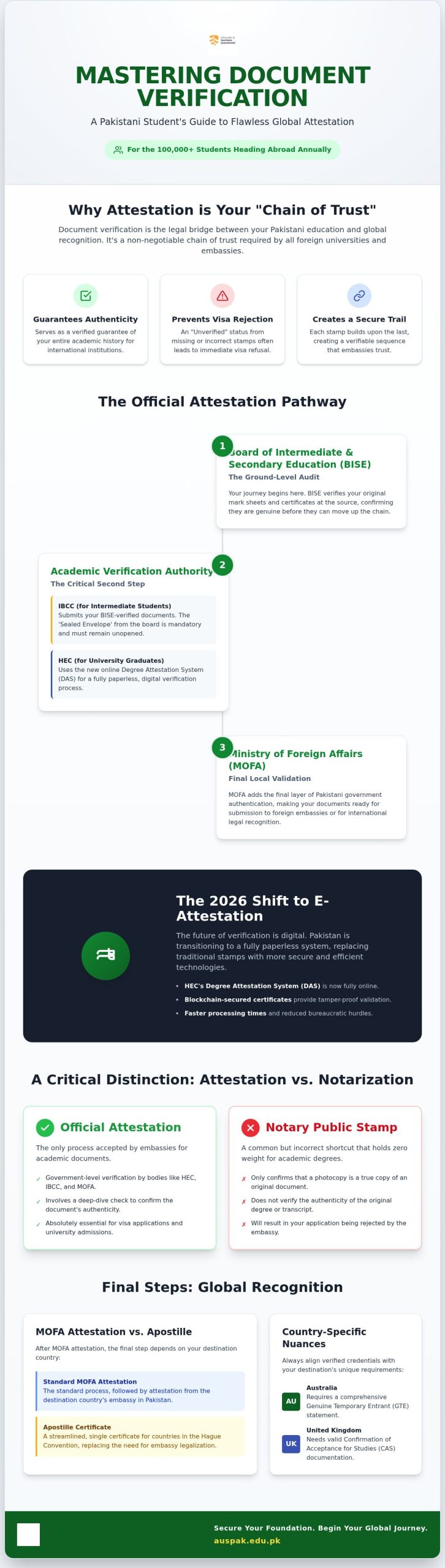
Country-Specific Documentation Nuances for 2026
Securing your official stamps from the HEC or MOFA is a monumental achievement, yet it represents only one half of the compliance journey. Each global destination interprets your academic history through its own regulatory lens, often requiring supplemental layers of validation that go beyond standard local attestations. To ensure a successful outcome, your document verification for abroad study Pakistan must be tailored to the specific evidentiary standards of your target country. Minor omissions in these country-specific details frequently result in Request for Information (RFI) notices that can delay your departure by months.
Australia: GTE and Document Integrity
Australian institutions have significantly intensified their scrutiny of international applications in 2026. Your verified academic records now serve as the primary evidence to satisfy the Genuine Temporary Entrant (GTE) requirement, which assesses your intent to study. Admissions officers look for a flawless “chain of trust” that proves your credentials haven’t been altered. Verified financial documents are equally critical, as they demonstrate your capacity to fund your education without local employment. Ensuring these papers are impeccable is a prerequisite for a successful Australian university admission for Pakistani students. AusPak International acts as a vital intermediary in this process, pre-verifying your documentation to meet the rigorous integrity standards of our 40+ partner universities.
UK and Canada: Specific Verification Hurdles
The United Kingdom places heavy emphasis on the Confirmation of Acceptance for Studies (CAS) document check. You must ensure your bank statements adhere to the strict 28-day rule, where the required funds remain untouched for a full month before your application is filed. Additionally, a TB test from an approved clinic is mandatory for all long-term students. For those targeting North America, the Canada Student Direct Stream (SDS) requires specific upfront documentation, including a Guaranteed Investment Certificate (GIC). Many programs also demand an Educational Credential Assessment (ECA) through agencies like WES to compare your Pakistani degree to Canadian standards. For a step-by-step breakdown of these permit requirements, consult our how to apply for Canada study permit from Pakistan guide.
European destinations like Germany or Hungary often require an extra step: official translations. Even after your documents have received the MOFA or Apostille seal, they may need to be translated into the national language by an embassy-approved translator. This ensures that local faculty can accurately assess your credit hours and curriculum content. Don’t leave these details to chance. Beyond securing your documents, it’s equally important to explore scholarships for Pakistani students that can help offset the significant financial costs of studying in Europe, Australia, or North America. If you’re feeling overwhelmed by these conflicting requirements, get a professional profile assessment from AusPak International to ensure your document verification for abroad study Pakistan is 100% compliant before you submit your final visa application.
How AusPak International Streamlines Your Verification Process
While the technical steps of document verification for abroad study Pakistan are now clear, managing these requirements while balancing exam preparation or employment is a significant challenge. AusPak International acts as your primary gateway, leveraging a legacy established in 1995 to simplify these multi-layered legal demands. We don’t just handle paperwork; we provide a strategic roadmap that transforms a stressful bureaucratic burden into a seamless transition. Our goal is to serve as your authoritative navigator through every commission and ministry requirement.
Our methodology begins with an Expert Profile Assessment. This critical first step allows our specialists to audit your academic and personal records to identify documentation gaps before you commit financial resources to document verification for abroad study Pakistan. By catching discrepancies early, we save you from the cycle of rejected applications and repeated fees. Our team’s direct coordination capabilities help you move through HEC and IBCC bottlenecks with efficiency that solo applicants rarely achieve.
Once your documents are stamped, our Visa Documentation Service focuses on preparing a file that commands respect at the embassy level. We ensure that every digital certificate and physical seal aligns perfectly with international compliance standards. This commitment to excellence continues even after your visa is granted through our Onshore Arrival Support, ensuring you have a reliable partner as you begin your studies in Australia, the UK, or Canada. Alongside your verified documents, a well-timed application for global scholarships available to Pakistani students in 2026 can significantly reduce your financial burden and strengthen your overall study abroad profile.
Our “Visa-Ready” Documentation Audit
The “Visa-Ready” audit is a rigorous internal review process designed to eliminate risk. We compare your attested papers against the most current 2026 embassy checklists to ensure zero margin for error. If a document has been flagged or contains a technical flaw, we provide precise guidance on rectifying the issue without forcing you to restart the entire sequence from scratch. This level of scrutiny provides the peace of mind that only an established industry leader can offer.
Book Your Consultation Today
Your global future starts with the right stamp today. Don’t let confusion or long wait times stall your ambitions. Visit an AusPak International office or contact us online to begin your professional profile assessment. As an added advantage for starting your journey now, we provide a Free IELTS Mock Test to help you gauge your language proficiency. Take the first step toward your international milestone and contact the expert consultants at AusPak International today. We are ready to help you secure the official recognition your academic career deserves.
Your Journey to Global Excellence Starts with Precision
Mastering document verification for abroad study Pakistan is more than a simple administrative task; it’s the foundation of your international credibility. By following the sequential “chain of trust” from local boards to the Ministry of Foreign Affairs, you ensure your credentials stand up to the rigorous scrutiny of global embassies. Whether you’re navigating the new digital HEC portal or securing an Apostille for European destinations, precision remains your greatest asset in avoiding visa rejections and administrative delays.
With 30+ years of excellence, AusPak International serves as your trusted navigator through this complex landscape. We leverage our partnerships with 40+ Australian universities and our official onshore office in Melbourne to provide a level of security that smaller agencies simply can’t match. Our expertise ensures that every document in your file supports your academic goals and meets the highest compliance standards. Don’t leave your aspirations to chance. Start Your Document Audit with AusPak International today and transform your academic records into a powerful gateway for success. Your global milestone is within reach, and we’re here to ensure every stamp brings you one step closer to your dream destination.
Frequently Asked Questions
Is HEC attestation mandatory for a UK student visa?
Yes, HEC attestation is mandatory for most UK student visa applications where the applicant holds a university degree. The UK Home Office and CAS-issuing institutions require these verified academic transcripts to confirm your eligibility for higher education. While some short-term foundation courses might have different rules, degree-seeking students must complete the HEC digital verification process. This ensures your credentials are recognized and prevents delays during the final visa submission.
How long does MOFA attestation take in Pakistan for 2026?
MOFA attestation typically takes between 3 to 7 working days if you process your documents through authorized courier services like TCS or Gerry’s. If you secure a digital appointment at a MOFA liaison office, the process is usually completed on the same day. However, obtaining an appointment slot can take several weeks due to high seasonal demand. We recommend starting this phase at least one month before your university deadline to avoid bottlenecks.
Can I study abroad with a duplicate degree if it is verified?
Yes, you can study abroad with a duplicate degree provided it is an official document issued by your university and has been verified by the HEC. Attestation authorities treat an official duplicate the same as an original, as long as it carries the institution’s authentic seal. You must ensure the duplicate is clearly marked as official and follows the standard document verification for abroad study Pakistan sequence before submission to the embassy.
What is the fee for IBCC document verification in 2026?
In 2026, the IBCC attestation fee is Rs. 1,200 for each original certificate and Rs. 800 for each photocopy. These fees are paid via designated bank challans and are a mandatory part of the secondary education validation process. Remember that your local board verification fees are separate and must be settled before you approach the IBCC. Always confirm the latest rates on the official portal before initiating your payment to avoid delays.
Do I need to verify my O/A Level certificates through IBCC?
Yes, O and A Level students must obtain an Equivalence Certificate from the IBCC to study abroad or apply for local recognition. The IBCC verifies your foreign results against the Pakistani grading system. Without this equivalence, your qualifications may not be recognized by certain embassies. It is a critical step for students pursuing document verification for abroad study Pakistan who did not follow the local matriculation system during their secondary education.
What happens if my document is found to be “fake” during verification?
If a document is identified as fraudulent, the HEC, IBCC, or MOFA will immediately confiscate the paper and blacklist the applicant. This often leads to a permanent ban on traveling to specific countries and potential legal prosecution under Pakistani law. Embassies share this data globally, meaning a single fake document can end your international career permanently. Always ensure your papers are genuine and obtained through official institutional channels before starting the attestation process.
Does Pakistan offer online document verification for study abroad?
Yes, the Higher Education Commission launched a fully online Degree Attestation System on May 11, 2026. This paperless process allows university graduates to upload their documents and receive blockchain-secured e-attestation certificates within 10 to 15 working days. While the Ministry of Foreign Affairs still requires physical stamps or courier interaction, the HEC’s digital shift has significantly modernized the landscape for university graduates. This system provides a verifiable certificate that is recognized by international institutions.
Can AusPak International verify my documents on my behalf?
AusPak International provides expert guidance and a comprehensive “Visa-Ready” audit, but students must typically initiate the verification through official government portals. We assist by identifying documentation gaps and ensuring your files meet the specific standards of our 40+ partner universities. Our role as a trusted navigator is to streamline the process, helping you avoid common errors that lead to rejections at the HEC, IBCC, or MOFA counters during your application journey.