A strong funding file shows that your stay in France is financially covered, not simply that money appears in an account. For the French student visa for Pakistani citizens, proof of sufficient funds is a core requirement, assessed against your planned period of study. Understanding how to document those funds, including when a sponsor is involved, helps make your application clear and complete.
It’s understandable to focus first on the balance you need to show. You also need to understand how financial evidence fits with admission, the Campus France process and the visa application from Pakistan. This guide explains the funding requirement, how sponsorship can support your evidence, and which documents and application stages to prepare.
Follow the steps in order to understand how eligibility, financial proof and the application process fit together, and what to prepare before moving forward with your study plans.
Key Takeaways
- Plan financial evidence around the length of your stay and organise documents that clearly show how your expenses will be covered.
- If a family member or another sponsor is funding your studies, understand how to present their support alongside your financial documents.
- Complete the required university acceptance and Études en France steps before moving to the visa application stage.
- Prepare for the application and biometrics process in Pakistan, including the required appointments and supporting paperwork.
- Review your eligibility, course details and travel preparations early so each stage of your study plan is aligned.
How much proof of funds do I need for a France student visa from Pakistan?
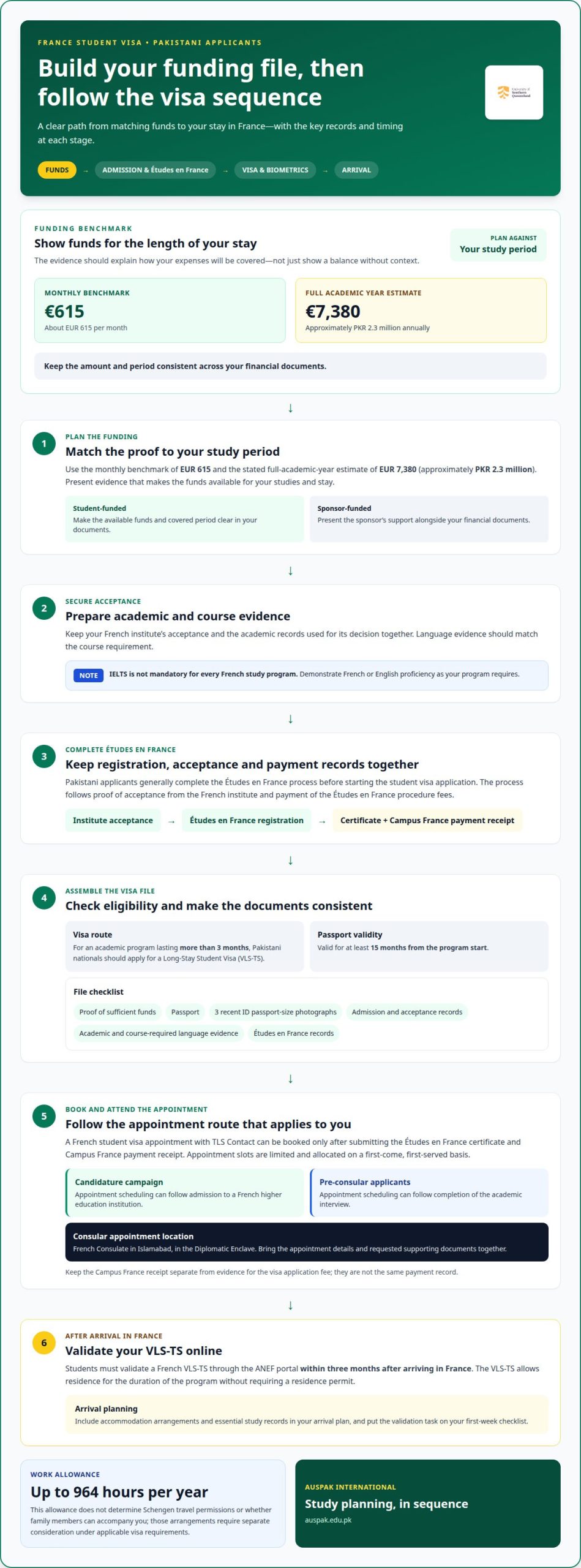
Plan to show about EUR 615 per month, or EUR 7,380 for a full academic year. The annual estimate is approximately PKR 2.3 million; your evidence should show sufficient funds for your stay, not just a balance without context.
A French long-stay student visa allows work up to 964 hours per year. That allowance does not determine Schengen travel permissions or whether family members can accompany you; those arrangements require separate consideration under the applicable visa requirements.
- Build the financial file around your study period. Match the funds shown to the length of your stay and the monthly benchmark of EUR 615. For a full academic year, the stated estimate is EUR 7,380, approximately PKR 2.3 million annually. Present financial evidence that makes the funding available for your studies and stay. Keep the amount and period clear across the documents you submit.
- Organise the student visa documents as a complete set. Prepare proof of sufficient funds, your passport, and 3 recent ID passport-size photographs. Keep admission and acceptance documents together with the financial evidence, so the application presents a connected study plan. For travel and settling in, organise your passport, visa-related papers, and admission records for access during the journey and after arrival.
- Connect Études en France registration with admission. Pakistani applicants generally complete the Études en France process before starting the student visa application. The process follows proof of acceptance from the French institute and payment of the Études en France procedure fees. Keep the acceptance and registration records with your application documents. This sequence helps show how your academic plan progresses from admission to the visa stage.
- Prepare academic and language evidence for your course. Include the academic documents that support your admission, such as the records used for the institute’s decision. Language evidence should match the course requirement: IELTS is not mandatory for every French study program, and applicants should demonstrate French or English proficiency as their program requires. Keep these documents consistent with the course and acceptance details.
- Review the eligibility details before submitting. Pakistani nationals planning an academic program lasting more than 3 months should apply for a Long-Stay Student Visa (VLS-TS). The passport should be valid for at least 15 months from the program start. Check that the passport, acceptance, academic records, photographs, and financial evidence form one coherent application before submission.
How professional support can guide your application steps and biometrics
Use professional guidance to keep the application sequence, fee records and appointment preparation aligned. For Pakistani applicants, the process includes Études en France records and a consular appointment in Islamabad.
Get professional support to complete the visa application
Start by organising your admission, Études en France certificate and supporting documents into a clear application file. A consultant can help map the required steps, identify missing records and keep the file in the right order for your case. Do not submit before completing the required Études en France stage, unless an exemption applies.
You can access an appointment after obtaining the required Études en France certificate and Campus France payment receipt. Slots are limited and allocated on a first-come, first-served basis, so coordinate the timeline rather than treating each stage separately.
Paying the visa application fees with professional guidance
Keep the Études en France payment receipt with your application records. Applicants can book a French student visa appointment with TLS Contact only after submitting the Études en France certificate and Campus France payment receipt. A consultant can help organise these records and explain when each payment evidence belongs in the process.
Check the relevant payment instructions to confirm how the fee should be paid. Keep its payment evidence separate from the Campus France receipt, rather than treating the two payments as one application charge. This distinction makes the payment record easier to follow.
Prepare for your biometrics appointment with professional support
When the appointment stage is available, organise your documents for the consular appointment at the French Consulate in Islamabad, in the Diplomatic Enclave. Have your appointment details and supporting file ready together. Follow the appointment instructions and bring the requested documents.
Applicants using the candidature campaign can schedule an appointment after admission to a French higher education institution. Pre-consular applicants can schedule after completing the academic interview. Check which route applies to you, since appointment timing depends on the process.
- Plan the first week after arrival. Add accommodation arrangements and essential study records to your arrival plan. Students must validate a French VLS-TS online through the ANEF portal within three months after arriving in France. The VLS-TS allows residence for the program’s duration without requiring a residence permit. Put this administrative task on your first-week checklist.
For guidance on study planning for another destination, explore study visa planning options.
University acceptance and Etudes en France registration
- Start the Campus France process early. For a September intake, work backwards from the academic calendar and plan to begin Campus France about four to five months before intake. This allows time to organise the admission file, complete the Études en France procedure and attend the academic interview. January or February are also listed as spring intake periods in France.
- Secure university acceptance before progressing. Students applying from their country of residence can submit a visa request after receiving proof of acceptance from their institute and proof of payment for the Études en France procedure fees. Keep the acceptance record with the course and academic documents in your application. These records link your chosen higher education program to your planned studies in France.
- Register through Études en France if the process applies. Pakistani applicants generally complete their Études en France application before starting the French student visa application. The process includes an academic interview at an Alliance Française in Islamabad, Lahore or Karachi. Scholarship holders may be exempt from the Études en France fee in Pakistan, while acceptance and registration documents remain central to the application sequence.
- Identify any process exception before opening a file. Études en France is not required for online academic programs involving no mobility to France, internships in France, or Pakistani nationals residing in the European Union. PhD programs with a doctoral fellowship are also exempt. Applicants admitted with a fellowship or to a post-PhD program should apply for a Talent Passport Long-Stay Visa. Pakistani applicants living or studying elsewhere must apply through Campus France in their country of residence and create a new file there.
- Align passport validity and living-cost planning. A Pakistani applicant’s passport should remain valid for at least 15 months from the academic program’s start. Check this against the course start date before proceeding with acceptance and registration documents. Living costs in France depend on the city and accommodation choice, so build a budget around the actual location and housing plan. Paris, Toulouse, Lyon and Bordeaux can involve different monthly student budgets.
- Keep documents consistent at every stage. Use the same course and institution details across acceptance records, Études en France registration and the visa file. If an exemption applies, follow the relevant visa route instead of creating an Études en France file unnecessarily. This keeps the admission decision, academic interview and visa application aligned.
Proof of funds and sponsorship
- Set the minimum funding target against your stay. The stated benchmark is EUR 615 per month, with EUR 7,380 for a full academic year. The annual estimate is approximately PKR 2.3 million. Treat these as planning figures for the required proof of sufficient funds, then organise evidence around your actual study period. The application should make clear what funds are available and how they support your stay.
- Arrange bank evidence across a consistent period. Prepare 3-6 months of bank statements as financial evidence. A sequence of statements helps present account activity over time, rather than showing only a single balance. Keep the account holder, statement period and available funds easy to identify. If funds come from more than one source, organise each source separately and explain how the amounts combine to support your education and living costs.
- Explain sponsorship clearly when someone else funds your studies. Include a signed sponsorship statement that identifies who will support you, which expenses they intend to cover and the period of support. Pair it with the sponsor’s financial evidence to show the connection between the commitment and available funds. Keep names and funding details consistent across the statement, bank records and application. Do not describe the support as complete if it covers only part of your expenses.
- Show scholarship funding as part of the overall picture. If you hold a scholarship, include its award documentation and identify the expenses it covers. Set that support alongside personal or sponsor funding, rather than treating the scholarship name alone as proof of available resources. The remaining funds should be presented clearly against the EUR 615 monthly benchmark and your study period. An English-language course does not replace financial evidence.
- Prepare a concise explanation for the application and interview. Summarise the funding plan in a few direct points: the source, amount available, period covered and any expenses paid through a scholarship or sponsor. Use the same figures and names as the supporting documents. This gives the reviewer a clear path through the evidence and helps you explain the minimum funding plan without conflicting details. Keep the statement factual, and do not present expected future income as money already available.
French student visa eligibility for Pakistani students
For studies lasting more than 3 months, Pakistani students should apply for a Long-Stay Student Visa (VLS-TS). It covers residence for the program’s duration without requesting a residence permit, but must be validated online through ANEF within three months after arrival.
- Match the visa category to your course. Pakistani students admitted to a French bachelor’s, master’s or PhD program without a doctoral fellowship should apply for the Student Long-Stay Visa. The course level and fellowship status matter: applicants admitted to a PhD with a doctoral fellowship follow a different route. Confirm the correct category before beginning the application process.
- Check your age and passport against the planned start. Applicants for a French higher education visa must be at least 18 years old when applying. Your international passport should remain valid for at least 15 months from the academic program’s start. Compare those dates early, because a passport expiry that falls too soon can disrupt an otherwise complete application.
- Connect eligibility to admission at a recognised institution. Keep your acceptance details consistent with the course and institution named in your visa file. Admission to a bachelor’s, master’s or eligible PhD program establishes the academic purpose of your application. Your documents should make clear what you will study, where you will study and how the program relates to your planned residence in France.
- Match language evidence to the program. IELTS is not mandatory for every French study program. Applicants should demonstrate proficiency in French or English as required by their chosen course. Use the institution’s stated language requirement to guide your evidence: an English-taught course and a French-taught course may require different proof.
- Complete the required platform and post-arrival step. Pakistani applicants generally complete Études en France before starting the visa application, except in the listed cases. After arrival, validate the VLS-TS online through ANEF within three months. This validation is essential to the residence process. The visa covers the program’s duration without a separate residence-permit request.
- Use the program duration as your eligibility checkpoint. The Long-Stay Student Visa route applies when a Pakistani national plans an academic program lasting more than 3 months. A shorter course does not meet that stated duration criterion, so identify the course length before selecting a visa category. The clear takeaway: check nationality, course duration, admission level, fellowship status, age and passport validity together.
AusPak International: UK Student Visa Consultancy
AusPak International supports students considering destinations beyond France, including those planning to study in the UK. Its UK Student Visa Consultancy provides visa-related guidance, while Australian University Admission Support and Canada Study Permit Assistance serve students pursuing those destinations.
If you plan to study in France, use the funding, admission and application steps above to organise your next decisions. If you are considering another destination, choose support that matches the country and process you intend to pursue. Onshore Arrival Support is also available to students preparing for arrival.
Contact AusPak International to discuss the study destination and support relevant to your plans.
Move forward with a clear study plan
Turn your French study opportunity into a well-organised decision by keeping your academic goals, funding plan and application timeline aligned. A clear plan helps you focus on the choices that matter instead of treating every document and deadline as a separate task.
The French student visa for Pakistani citizens is one part of a wider education journey. If you’re also considering a study destination supported by AusPak International, discuss how your goals fit the relevant application pathway before committing to your next move.
Contact AusPak International for application support to discuss the study route that matches your plans. Take the next step with purpose and keep your education goals in sight.
Frequently Asked Questions
Need Help With Your France Study Visa?
Prepare your French study plan by organising admission, financial evidence and application stages together. AusPak International offers Australian University Admission Support, UK Student Visa Consultancy and Canada Study Permit Assistance for students pursuing those destinations. Its listed services do not include French student visa consultancy, so this FAQ focuses on practical information for understanding the France application process. Keep your destination and support needs aligned before proceeding with any study plan.
Why do France study visas get refused for Pakistani students?
A refusal may be contested as indicated on the refusal notification, and the French consulate makes the visa decision. Read the notification closely to understand the stated basis and any appeal route it identifies. For example, compare the reason given with the course and financial evidence in the submitted file. Treat the refusal notice as the starting point for determining what action is available, rather than assuming an outcome.
Is IELTS required to study in France?
No, IELTS isn’t mandatory for every French study program. Language evidence depends on the institution’s requirements and whether the course is taught in English or French. For example, an applicant to an English-taught degree should prepare the proficiency evidence accepted for that program, while a French-taught course may require French-language evidence. Use the admission information to identify the course’s language requirement and make sure your application reflects it.
What are the eligibility requirements for a French student visa for Pakistani citizens?
Eligibility depends on the course, admission and applicant’s circumstances. For a program lasting more than 3 months, Pakistani nationals should apply for a Long-Stay Student Visa (VLS-TS); higher education applicants must be at least 18 when applying. A bachelor’s, master’s or PhD admission without a doctoral fellowship follows the Student Long-Stay Visa route. Passport validity and any fellowship-related exception also affect which application pathway applies.
What documents are required for a French student visa application from Pakistan?
Prepare documents that establish identity, admission, academic background and financial support. The application document list includes 3 recent ID passport-size photographs, while the study file should connect the institute’s acceptance with academic records and any required language evidence. Keep Études en France records with the visa documents where that procedure applies. Arrange documents by purpose, so an appointment file is easier to review than an unsorted collection.
What are the current French student visa fees and service charges in Pakistan?
Budget for separate French visa and Études en France payments, rather than treating them as one charge. The visa fee is paid at the consulate, while the Campus France procedure has its own payment and receipt. Consultancy service charges depend on the case and are given after a quote request; factors include the application support scope and document preparation involved. Keep each payment record distinct for your application file.
How much proof of funds is required for a French student visa, and what financial evidence is accepted?
Plan around EUR 615 per month, with EUR 7,380 as the estimate for a full academic year. Bank statements covering 3-6 months are listed as financial evidence. If a sponsor contributes, present their support alongside evidence of funds and explain which study-period expenses it covers. Scholarship documentation can also clarify funding. Keep the source, amount and period understandable across the evidence you submit.
How can a consultant help Pakistani students book a French visa appointment and submit their application?
A consultant can help organise the application sequence and keep appointment documents together. The appointment can be booked with TLS Contact after submitting the Études en France certificate and Campus France payment receipt. Applicants attend the consular appointment at the French Consulate in Islamabad. Appointment timing depends on the application route: candidature applicants can schedule after admission, while pre-consular applicants schedule after the academic interview.