
What if the most prestigious name on your shortlist is actually the wrong choice for your specific career path and visa eligibility? It’s a question that keeps many ambitious Pakistani students awake at night, especially when the pressure to succeed is compounded by the rising costs of international tuition. You’ve likely spent hours analyzing the latest qs ranking data, yet you still feel a mix of excitement and deep-seated confusion about what these numbers actually mean for your professional future. We understand that you aren’t just looking for a school; you’re looking for a high ROI and a clear path to a successful visa outcome.
This comprehensive guide will help you master the complexities of the 2026 rankings to ensure your international education journey is both strategic and successful. We’ll decode the latest QS metrics and help you shortlist universities that balance global prestige with attainable entry requirements. You’ll gain the clarity needed to choose an institution that supports your academic goals and your visa application with absolute confidence. Let’s transform your uncertainty into a structured plan for global advancement.
Key Takeaways
- Understand how the 2026 methodology shifts toward sustainability and employability to better reflect your future career prospects in a competitive global market.
- Learn why a university’s subject-specific performance is often a more accurate indicator of departmental funding and expertise than its overall global position.
- Discover the critical link between choosing a high-tier institution and satisfying the “genuineness” requirements for your student visa application.
- Master the process of filtering the qs ranking to create a strategic shortlist that balances academic prestige with your specific entry requirements.
- Prepare for admission into top-ranked schools by utilizing a free IELTS mock test to assess your readiness for international standards.
What is the QS World University Ranking and Why Does it Matter in 2026?
The QS World University Ranking is a multi-metric evaluation of over 1,500 institutions globally. For students across Pakistan, this system serves as the primary benchmark for institutional quality and global prestige. It isn’t merely a list of names; it’s a data-driven assessment of where your investment will yield the highest return. As you prepare for the 2026 intake, understanding these metrics becomes vital. This specific year marks a pivotal moment in international education because the evaluation criteria now place a much higher premium on sustainability and employment outcomes. These changes reflect a world that values practical impact as much as academic theory.
Securing a degree from a highly-ranked institution establishes an immediate international “brand value” for your profile. When you graduate, you aren’t just carrying a piece of paper; you’re carrying the reputation of a world-class faculty. This recognition is essential for navigating the competitive landscape of international job markets and ensuring your qualifications are respected by global regulatory bodies. It’s about future-proofing your career before you even step onto campus.
The Global Standing of QS vs. Other Ranking Systems
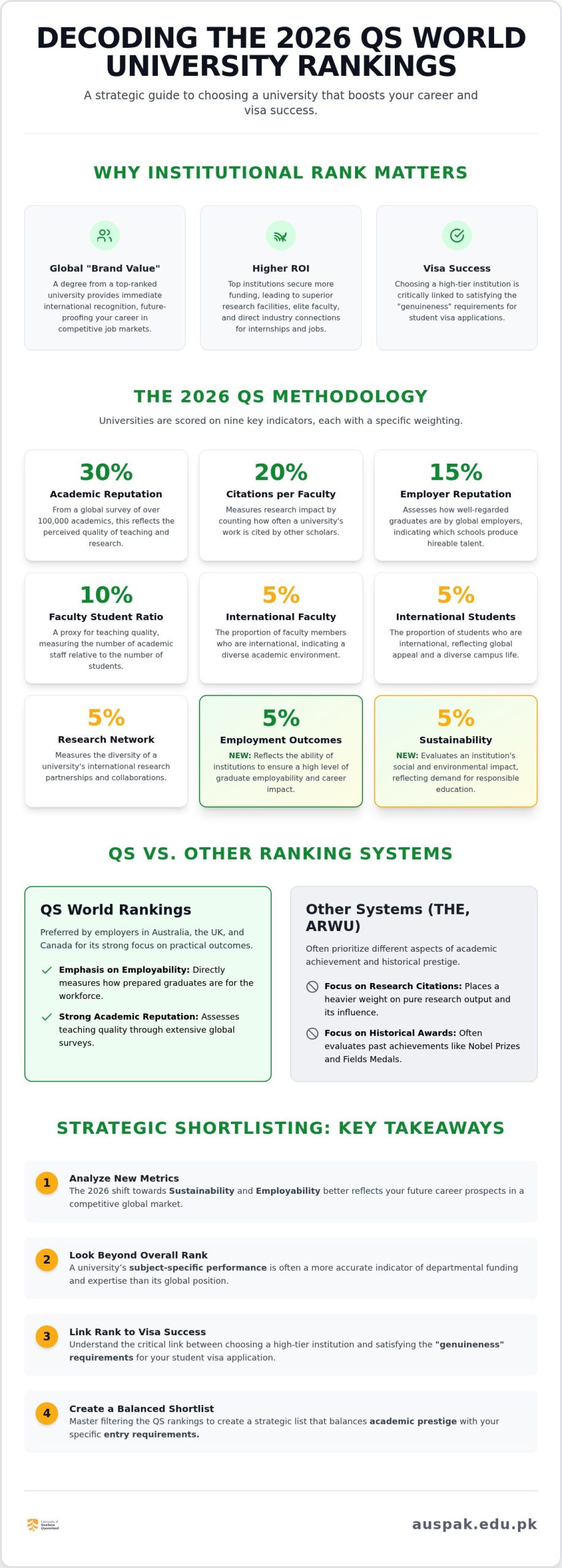
While several systems evaluate higher education, the qs ranking stands out for its unique emphasis on employability and academic reputation. Systems like the Times Higher Education (THE) often prioritize research citations, while the ARWU focuses on historical awards like Nobel Prizes. In contrast, QS is the preferred tool for employers in Australia, the UK, and Canada. These regions value the “Employer Reputation” metric, which directly correlates with how prepared graduates are for the workforce. For a Pakistani student, this distinction is critical. If your goal is to return home or work for a multinational, the prestige associated with QS-ranked schools provides a significant competitive edge during the recruitment process.
Why Pakistani Students Should Care About Institutional Rank
Institutional rank influences every aspect of your educational experience. Higher-ranked universities often secure more funding, which results in superior research facilities and a more diverse, international faculty. This environment doesn’t just teach you a subject; it reshapes your worldview. There’s also a clear link between a university’s rank and the quality of its career services. Top-tier schools have deep-rooted connections with industry leaders, offering you a direct pipeline to internships and graduate roles. Beyond the logistics, the psychological benefit of attending a globally recognized institution cannot be overstated. It builds a level of confidence that stays with you throughout your career, knowing your academic background meets the highest international standards.
Deciphering the 2026 QS Methodology: How Universities are Scored
The qs ranking operates on a rigorous framework designed to provide a 360-degree view of institutional performance. For the 2026 cycle, the evaluation relies on nine specific indicators that weigh everything from research impact to global visibility. You can explore the full technical breakdown in the official 2026 QS Methodology. Understanding these metrics is the first step toward making a data-driven decision for your future.
Academic Reputation is the cornerstone of this system. It isn’t just a popularity contest; it’s a massive survey of over 100,000 experts globally. This metric reflects the perceived quality of teaching and the academic standards you’ll encounter in the classroom every day. If you’re planning a post-graduate research degree, “Citations per Faculty” is your most important metric. It measures the frequency with which a university’s research is referenced by other scholars, signaling high-level innovation and expert faculty. Meanwhile, “Employer Reputation” measures how well-regarded a university’s graduates are in the professional world. This metric directly impacts your post-graduation job search, as it identifies which schools produce the most hireable talent in the eyes of recruiters.
The New Frontier: Sustainability and Employment Outcomes
QS introduced “Sustainability” as a core metric for the 2026 rankings to reflect the growing demand for socially responsible education. This isn’t just about environmental policy; it’s about how an institution prepares you to solve complex global challenges. “Employment Outcomes” is another vital addition. It measures a university’s ability to ensure its graduates find high-quality employment quickly. For Pakistani students, these metrics are essential for finding future-proof careers that offer a strong return on investment. To understand how these metrics apply to your specific academic profile, you can consult with an expert advisor to build a data-backed strategy.
Understanding International Student and Faculty Ratios
A high “International Student Ratio” is a strong indicator of a diverse, welcoming environment for Pakistanis. It suggests the campus has the infrastructure to support global learners and foster a multicultural community. Equally important is the “Faculty-Student Ratio,” which measures the number of academic staff available per student. A lower ratio often results in better mentorship opportunities and more personalized learning support. This balance ensures you aren’t just another number in a crowded lecture hall, but a student with direct access to expert guidance.
Beyond the Top 10: Using Subject Rankings for Strategic Career Planning
Don’t let a global number limit your potential. While an institution’s overall qs ranking provides a snapshot of its general prestige, the real value for your career often lies in the specific department. A university ranked #200 globally could easily be the world leader for Civil Engineering or Data Science. This discrepancy happens because research funding and faculty expertise are often concentrated in specific departments rather than spread evenly across a whole campus. You’re studying a subject, not a whole university, so your focus should be on where that subject is most respected by those in the industry.
Choosing a niche leader offers a strategic advantage. If you’re pursuing emerging fields like AI, Renewable Energy, or Sustainable Architecture, a university with a “Power of Four,” a group of at least four high-impact, world-renowned researchers in that specific niche, will offer better networking and research opportunities than a “Top 10” generalist school. This approach ensures you’re learning from the people actually defining the future of your industry. You can see how these specific weightings differ by examining the QS World University Rankings methodology, which highlights how departmental performance is assessed through academic and employer surveys.
Top Subjects for Pakistani Students: Engineering, Medicine, and Business
For students from Pakistan, fields like STEM and Business remain the most popular pathways for global advancement. Identifying the highest-ranked departments in these areas is crucial for ensuring a strong return on your educational investment. Instead of chasing a generic name, look for schools where the faculty is deeply integrated with industry partners and global research networks. Our Australia University Guide 2026 for Pakistani Students provides a detailed breakdown of which Australian institutions lead in these specific sectors. Prioritizing a top-ranked subject department ensures you graduate with specific skills that are in high demand by recruiters at multinational firms.
Regional Rankings: Finding Excellence Closer to Home
Budget constraints shouldn’t force you to compromise on academic quality. The qs ranking for regional hubs like Asia provides a wealth of high-tier options that are often more affordable than their Western counterparts in terms of both tuition and living costs. Comparing European subject leaders with North American schools can also reveal hidden gems that offer similar prestige at a more accessible price point. These regional rankings are an excellent alternative for students who want a world-class education without the extreme financial burden of a top-10 global institution. It’s about finding the right balance between academic excellence and financial sustainability while still securing a degree that carries international weight.
The Relationship Between University Ranking and Visa Success
Choosing a university isn’t just an academic decision; it’s a strategic legal move. When a visa officer reviews your application, they evaluate the “genuineness” of your intent based on the institution you’ve selected. A high qs ranking serves as a powerful endorsement of your academic profile. It demonstrates that you’ve prioritized quality education over easier entry routes, which significantly reduces the perceived risk of your application. While many believe you must secure a spot in the Top 50 to guarantee success, this is a common misconception. Institutions within the Top 500 or even the Top 800 globally provide a sufficiently strong foundation to satisfy most immigration departments that your primary goal is education.
A reputable rank also simplifies the financial justification process. Visa officers are more likely to view a high-cost degree as a legitimate investment when it’s tied to a globally recognized institution. This alignment between your financial output and the university’s prestige helps prove that you’re a serious student seeking a verifiable asset for your future career. It’s about building a narrative of academic excellence that leaves no room for doubt regarding your intentions.
Rankings and the Australian GTE Requirement
Australia’s student visa system relies heavily on the Genuine Temporary Entrant (GTE) requirement. Choosing a reputable, ranked university strengthens your case by showing a logical and ambitious progression in your education. For deeper insights into this process, read our guide on GTE Requirements for Australian Student Visa Explained. Opting for unranked or “Tier 3” institutions often triggers higher scrutiny, as officers may question why a student would travel across the world for a school with no global standing. High-ranked universities have established trust with the Department of Home Affairs, which can lead to smoother processing for their applicants.
Visa Perceptions in the UK and Canada
In the UK, the “Quality of Institution” metric is a subtle but critical factor in visa processing. Officers look for a clear match between your previous grades and the ranking of your chosen university. Similarly, the university’s reputation is a pillar of a successful Canada Study Permit from Pakistan. You must balance the university rank with a powerful Statement of Purpose (SOP) to prove your academic intent. A high rank acts as a silent witness to your credibility, making it much easier to argue that your move to Canada is driven by a desire for world-class training rather than other motives.
Secure your future with a university that supports your visa goals. Contact us for a professional profile assessment to ensure your choice meets the highest immigration standards.
How to Use QS Rankings to Shortlist Your Dream University with AusPak
Shortlisting the right institution requires more than just looking at a global number. It demands a structured approach that aligns your specific academic background with global market realities. You must move beyond the surface level to find a school that matches your ambition. Follow these four strategic steps to build a shortlist that works for you. First, identify your core career goals and preferred subject area. Second, filter the qs ranking 2026 data specifically by subject rank and employer reputation to see which schools are truly respected in your chosen field. Third, cross-reference your findings with AusPak’s extensive partner university list to maximize your admission chances. Finally, book a detailed profile assessment with a Best Study Abroad Consultant in Pakistan to turn your research into a final, actionable application strategy.
Personalised Profile Assessment: Beyond the Data
Your GPA and IELTS scores are the ultimate gatekeepers to international education. They determine which tier of the qs ranking is realistically within your reach and where you might need to strengthen your profile. We help you bridge the gap between your current academic standing and the strict entry requirements of top-tier global schools. This process isn’t just about meeting a minimum; it’s about exceeding the expectations of competitive admissions committees. Utilizing our IELTS for Australian Student Visa Guide is a critical step in ensuring you meet the specific language benchmarks required for rank-based entry. We provide the roadmap to ensure your scores reflect your true potential.
The AusPak Advantage: 30 Years of Ranking Expertise
With 30 years of industry experience, we understand that academic prestige must be balanced with financial sustainability. Our team uses deep institutional data to find the “sweet spot” between a university’s rank and its overall affordability for Pakistani families. We manage every aspect of your University Application Assistance to ensure your submission is flawless and stands out to admissions officers at the world’s most competitive institutions. This high-level support reduces your anxiety and provides a structured path forward. Ready to start your journey? Consult with AusPak International today to align your career goals with the world’s best universities.
Secure Your Global Future with Strategic Academic Choices
Navigating the 2026 academic landscape requires more than just high ambitions; it demands a data-driven strategy that aligns your profile with the right global institutions. You’ve learned that the qs ranking is a multi-dimensional tool that impacts everything from your classroom experience to your ultimate visa approval. By prioritizing subject-specific excellence and understanding the shift toward employability and sustainability, you’re now equipped to make a choice that guarantees a high return on your investment. Choosing the right university is the first step in a lifelong career journey.
Success in international education is rarely a solo journey. With over 30 years of industry experience and partnerships with more than 40 Australian universities, AusPak International acts as your trusted navigator. We provide expert guidance on GTE and complex visa documentation while offering unique on-shore support at our Melbourne office to assist you upon arrival. Don’t leave your future to chance when you can rely on proven expertise. Begin your journey with a professional profile assessment at AusPak International and transform your global aspirations into a tangible reality. Your path to excellence starts today.
Frequently Asked Questions
What is a “good” QS ranking for a university?
A “good” ranking depends on your academic goals, but generally, any institution in the top 500 globally is considered high-tier. For Pakistani students, securing a place in the top 800 still provides significant international brand value and satisfies most visa requirements. It’s better to focus on a university that balances global prestige with entry requirements you can realistically meet. Always check the subject-specific qs ranking for a more accurate view of departmental quality.
Does a university ranking affect my student visa approval?
Yes, university ranking is a critical factor that visa officers use to assess the genuineness of your academic intent. High-ranked institutions are often viewed as lower risk, which can lead to smoother processing for Australian GTE or UK visa applications. While a high rank doesn’t guarantee approval, it strengthens your case by demonstrating a clear commitment to quality education rather than simply seeking a pathway to immigration or low-skilled work.
Is the QS ranking more important than the Times Higher Education (THE) ranking?
The importance of a ranking system depends on your destination and career goals. The qs ranking is often considered more influential for employers in Australia, the UK, and Canada because it heavily weighs employer reputation and graduate employability. While THE focuses more on research citations, QS provides a more balanced view of how a degree will perform in the job market. Most global consultancies use QS as their primary benchmark for institutional quality.
Can I get into a top 100 QS-ranked university from Pakistan?
Absolutely, many Pakistani students successfully enroll in top 100 universities every year by meeting high GPA and IELTS requirements. These institutions look for strong academic backgrounds and clear statements of purpose. You’ll need to prepare your documentation meticulously and ensure your profile matches the university’s specific entry criteria. We provide profile assessments to help you determine which top-tier schools are the best match for your current qualifications and career ambitions.
How often are the QS World University Rankings updated?
The rankings are updated annually to reflect the most recent data on academic reputation, research impact, and employer feedback. Each new cycle, such as the upcoming 2026 release, introduces updated metrics that can cause institutions to shift positions. Staying informed about these yearly changes is vital for students planning their applications well in advance. It ensures you’re making decisions based on the most current global standards and institutional performance across all nine key indicators.
What is the difference between a global ranking and a subject ranking?
A global ranking evaluates the university as a whole across all departments, whereas a subject ranking focuses on the performance of a specific field of study. For example, a university might be ranked #300 globally but #10 for Mechanical Engineering. For career planning, the subject ranking is often more relevant because it reflects the specific funding, faculty expertise, and industry connections available in your chosen department. It’s where you’ll spend your time.
Are rankings relevant for students applying for a Master’s or PhD?
Rankings are highly relevant for post-graduate students because they indicate the level of research funding and faculty expertise available. A high “Citations per Faculty” score is a key indicator of a university’s contribution to global knowledge, which is critical for research-based degrees. Master’s students should look closely at “Employer Reputation” to ensure their advanced degree carries weight in the professional world after graduation. Higher-ranked schools often have better-equipped laboratories and research facilities.
How does AusPak help me choose the right university based on rankings?
AusPak acts as your trusted navigator by cross-referencing your academic profile with the latest institutional data. We help you find the “sweet spot” between high-tier prestige and your specific budget or entry requirements. With partnerships with over 40 Australian universities and institutions across the UK and Canada, we provide expert guidance on GTE and visa documentation that rankings alone cannot solve. Our Melbourne office also provides local on-shore support once you arrive in Australia.