
A gap between what your statement says and what your documents show can weaken an otherwise clear study plan. For students applying from Pakistan, avoiding common statement of purpose for Canada study permit mistakes means more than polishing the writing. Your reasons for studying should make sense alongside your academic history, chosen programme, career goals, and supporting evidence.
It can be difficult to know what an officer needs to understand, especially when you’re explaining why you chose a particular programme and Canada. A useful statement is personal, clear, and consistent. It does not rely on broad claims or promises without evidence. Use this checklist to identify weak explanations, unsupported details, and conflicts between your study plan and application documents before submission.
You’ll learn how to connect your previous education to your next step, explain your programme choice and future plans, and check that your evidence supports what you say. Requirements can change, so verify current instructions with IRCC before applying. If you need another set of eyes, Canada study permit assistance can include reviewing your statement alongside relevant academic and financial documents.
Key Takeaways
- Identify statement of purpose for Canada study permit mistakes that make your explanation unclear, generic, or difficult to support.
- Show how your previous education, chosen programme, and realistic next steps fit together in a coherent study plan.
- Compare your statement with your application documents to catch conflicting names, dates, programme details, or funding explanations.
- Edit in focused passes to remove repetition, vague praise, irrelevant details, and claims without evidence.
- Understand what a professional document review may help you check, and why you must verify current instructions and keep all information truthful.
Canada Study Permit Statement Mistakes That Can Weaken Your Explanation
Explaining a major education decision clearly and honestly can feel like a lot of pressure. If a statement of purpose or letter of explanation is requested or included in your application, use it to explain why you plan to study, why you chose a particular programme, and how it fits your plans. Requirements vary, so check the latest Immigration, Refugees and Citizenship Canada (IRCC) instructions and your application checklist instead of assuming every applicant needs the same documents. The term international student is used in different contexts, and a general definition cannot replace instructions for your specific application.
Apply one test to each important point: Can a reader understand this claim, and can your application support it? If you describe your previous studies, for example, compare the dates and qualification details with your academic records. If you explain how you’ll fund your education, make sure the statement matches the relevant financial evidence. This check helps prevent statement of purpose for Canada study permit mistakes that make a serious plan harder to assess.
Why generic or copied statements fail to explain your case
Template language can sound polished while leaving out the details that make your decision understandable. Saying Canada offers “excellent education” or that a school has a “great reputation” does not explain why this programme suits your background. Instead, identify a relevant feature you have verified, such as the subject matter or programme level, and explain why it matters to your next step.
Sample wording can also introduce details that do not fit your academic history, experience, or goals. Do not borrow a claim just because it sounds persuasive. Use samples to understand possible structure, then write in your own words. Check every personal detail against your records and circumstances.
The difference between a clear explanation and an unsupported promise
A credible intention is specific and grounded in what you can explain or document. An unsupported promise predicts an outcome you cannot control, such as claiming a particular job or career result is certain after graduation. Describe your goals as plans, explain the reasoning behind them, and check that they do not conflict with other information in your application.
Clear writing can help explain your rationale, but it cannot guarantee a study permit decision. Avoid dramatic assurances and focus on accurate, relevant detail. Accuracy and consistency make a more credible explanation than grand claims.
Build a Credible Study Plan: Connect Your Background, Programme, and Goals
A credible study plan connects what you have studied or done, why you selected this programme, and how it relates to realistic next steps. Each part should lead naturally to the next. If your proposed course seems unrelated to your earlier education or experience, explain the reason for the change rather than expecting the reader to infer it.
Treat your statement as an explanation, not a prediction. IRCC’s current document guidance can help you understand what to prepare and what to consider regarding your responsibilities as an international student. Check the instructions that apply to your application before finalising your study plan.
Explain why this programme fits your academic history
Connect the programme to relevant subjects, qualifications, or work experience. For instance, an applicant with a business background who is considering a data-focused programme could explain which earlier studies prompted that interest and what new skills the course is intended to develop. This example works only if it reflects the applicant’s actual experience.
Refer to specific curriculum features or the programme’s level only after checking the institution’s own materials. If your record includes a study gap, a change of field, or a progression that may seem unclear, provide truthful context and make sure it matches your application documents. Do not invent reasons or present an unverified course feature as fact.
Make your future goals specific without overstating certainty
Describe the knowledge or skills you hope to gain, then connect them to a plausible career direction. You could explain how a subject area relates to work you have done or a role you intend to pursue. Avoid unsupported salary figures, promises of employment, or claims that a particular immigration outcome is certain. You can explain your current intentions, but you cannot guarantee a future result.
Any return plan should reflect your genuine circumstances, not be framed as a promise that will ensure approval. Do not claim that one career outcome, destination, or intention guarantees a decision. The aim is to make your choices understandable, not to predict an officer’s conclusion.
A coherent study plan links your past education, the programme’s verified features, and realistic goals in a way your documents can support. That connection helps avoid statement of purpose for Canada study permit mistakes based on vague reasoning or overstated plans. If you’d like help checking how your study plan aligns with your academic and financial documents, explore Canada study permit assistance from AusPak International.
Check Your Statement Against Your Documents Before Submission
A statement can sound convincing on its own and still raise questions if it conflicts with the rest of your application. Before submitting, compare each important claim with the records available to support it. Required documents vary by applicant and application, so use the current IRCC instructions and your personalised application checklist rather than assuming everyone needs the same set.
A simple comparison table can make gaps easier to spot. Create three columns: claim in my statement, record that supports it, and mismatch or clarification needed. Check key details such as your name, education dates, programme information, study gaps, and explanation of how your studies will be funded. If a claim has no supporting record, decide whether it needs truthful context, additional evidence, or removal.
Find inconsistencies in education, dates, and programme details
Check programme names and details against your admission information, and compare your education history with your academic records. A minor difference in wording may not matter, but do not leave a meaningful discrepancy unexplained. Confirm that dates and transitions, including any study gap, align with your records and the timeline in your statement.
For example, if your statement says you completed a qualification in one year but your academic record shows a different completion date, clarify the timeline truthfully instead of changing the account to make it appear smoother. Note unclear transitions and explain them briefly using factual context. Never alter or conceal genuine discrepancies.
Make financial explanations match the available evidence
Describe funding in a way that reflects your circumstances and the records you are submitting. If a family member is supporting your studies, identify that arrangement clearly and make sure your explanation matches the relevant evidence. Do not claim funds are available, that someone will pay expenses, or that a source will cover costs unless your statement and supporting documents substantiate it.
Financial documentation and application instructions can change. Check IRCC’s current guidance before applying to confirm what financial evidence applies to your situation. Do not rely on an old checklist or another applicant’s document set.
Use this final cross-check before submission:
- Are names and dates consistent across the statement and relevant records?
- Do your education timeline and any gap explanations match your academic history?
- Do programme details agree with your admission information?
- Does each funding claim accurately reflect the evidence provided?
Resolve issues with accurate explanations, not assumptions. Comparing your documents carefully can catch statement of purpose for Canada study permit mistakes before they create avoidable questions about your application.
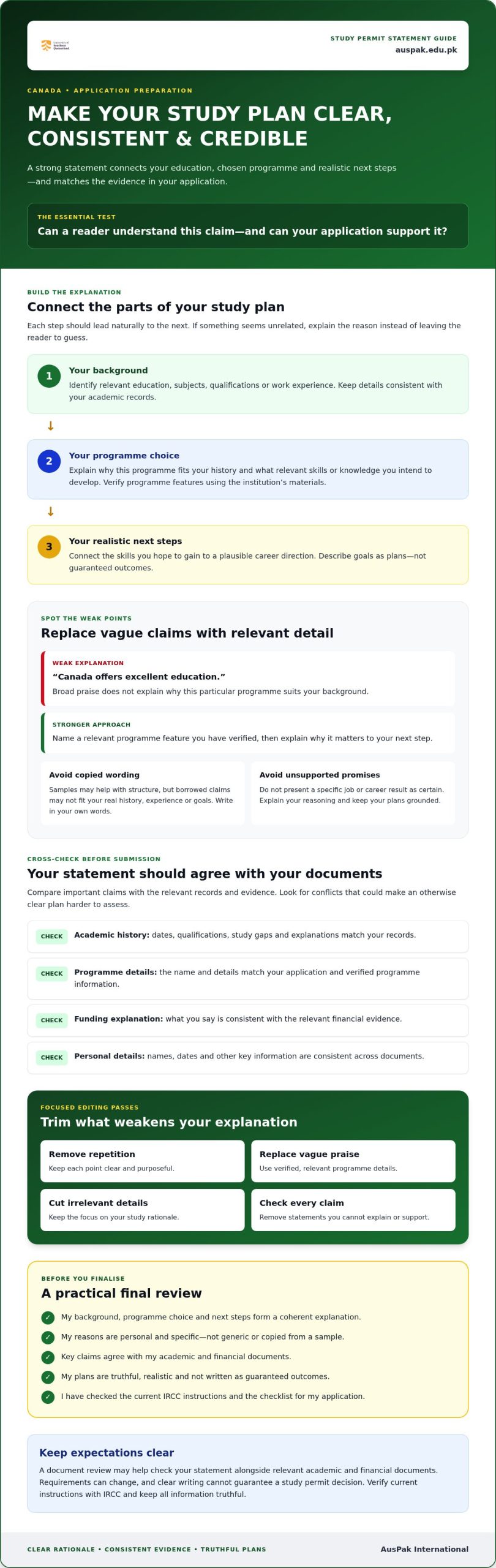
Use This Final Checklist to Edit Your Canada Study Permit Statement
Do not try to fix every sentence at once. Review your statement in focused passes so you can assess its purpose, reasoning, evidence, and accuracy separately. This approach helps catch statement of purpose for Canada study permit mistakes such as repeated explanations, vague praise, unsupported claims, and details that distract from your study plan.
A five-pass edit for clarity and credibility
- Pass 1: Purpose. Check that the statement directly explains why you plan to study and what you want the reader to understand about your decision. Cut openings that delay the explanation.
- Pass 2: Programme fit. Make sure your reasons for choosing the programme connect to your background and plans. Replace general compliments about Canada or the institution with relevant, verifiable details.
- Pass 3: Evidence. Review each major factual claim. Can you support it with information in your application or explain it truthfully? Delete or qualify claims that go beyond what you know.
- Pass 4: Consistency and clarity. Compare key details with the rest of your application. Simplify long sentences, remove repeated explanations, and cut irrelevant information.
- Pass 5: Final accuracy. Check names, dates, programme details, and all other facts. Before submitting, compare the statement with current IRCC instructions and the document checklist for your application.
Keep the final version focused. Each paragraph should clarify your purpose, programme choice, relevant background, or plans. If a sentence repeats an earlier point or uses broad praise without explaining your reasons, revise or remove it.
When to get a second review
Consider asking for a review if a change in academic direction, a study gap, a funding explanation, or a difference between documents is difficult to describe clearly. Ask the reviewer to flag confusing or unsupported wording, not to invent facts or promise an outcome. You remain responsible for the accuracy of your application, and no adviser can control the decision.
For wider context on preparing an application from Pakistan, consult this Canada study permit application guide and verify current requirements with IRCC. If you’d like support checking your statement alongside relevant application documents, explore Canada study permit assistance from AusPak International.
Get Expert Support Without Relying on Templates or Approval Promises
A second review can help you assess whether your statement is clear, relevant to your circumstances, and consistent with the documents you plan to submit. It may also identify wording that needs clarification or claims that lack support. Consultancy support does not replace current Immigration, Refugees and Citizenship Canada (IRCC) instructions, and no adviser can control the decision or guarantee approval.
Canada study permit assistance may include reviewing a statement alongside relevant academic and financial documents. Before sharing your materials, ask what the review covers. A useful review should help identify questions to resolve, not make your account sound persuasive by adding details that are not true. Avoiding statement of purpose for Canada study permit mistakes means retaining ownership of the facts and checking each claim yourself.
Questions to ask before choosing application support
Set clear expectations before arranging a review. Ask whether it covers the statement alone or also compares it with admission information, academic history, and relevant supporting records. Clarify how the adviser will flag errors, missing information, or details that need your explanation. Ask how you’ll be directed to verify current instructions if requirements have changed. Treat any promise of guaranteed approval as a warning sign, not a reason to proceed.
Prepare for a focused review of your application
Organise the materials you want checked so the review can focus on your questions. Depending on your application, these might include:
- Your current statement and admission information
- Academic history and records relevant to your explanation
- Supporting documents connected to claims made in the statement, including funding information where applicable
- A short list of unclear transitions, discrepancies, or claims you want to verify
Document requirements vary, so confirm the relevant checklist and instructions directly with IRCC before submitting. Review suggested changes carefully. Your information must remain truthful, and you are responsible for checking that the final application is complete and accurate.
If you’d like support reviewing your study permit documents, explore Canada study permit assistance from AusPak International. Use a review to improve clarity and consistency, not as a shortcut around official guidance or a promise about the outcome.
Make Your Study Plan Clear, Consistent, and Ready for Review
A strong study permit statement does not depend on grand promises. It explains your purpose, connects your academic background to your chosen programme and future goals, and stays consistent with the information in your application. Before submitting, check important claims against supporting documents, remove vague or repeated wording, and confirm current instructions for your application with IRCC.
These checks can help you catch statement of purpose for Canada study permit mistakes that make your plans difficult to understand or verify. Keep your account truthful and specific to your circumstances. A professional review may identify unclear explanations or document inconsistencies, but it cannot guarantee a decision or replace official guidance.
AusPak International offers Canada study permit assistance, including application processing and visa documentation support. If you’d like guidance reviewing your study permit documents, request guidance on your Canada study permit documents.
Prepare carefully, ask questions, and approach your next step with confidence. A clear, evidence-backed application starts with an honest account of your plans.
Frequently Asked Questions
Is a statement of purpose required for every Canada study permit application?
Not necessarily. Follow the current IRCC instructions and the personalised checklist for your application. Document requirements can vary, so do not assume a statement is mandatory for every applicant or that another student’s checklist applies to you. If you choose or are instructed to provide a letter of explanation, make it relevant to your circumstances and ensure its details match the rest of your application.
What should I avoid writing in a Canada study permit statement?
Avoid copied template wording, vague praise of Canada or an institution, unsupported claims, and promises about specific future outcomes. Leave out irrelevant personal details and statements that conflict with your academic, admission, or financial information. Explain your study purpose and programme choice using truthful, relevant details. Check that every claim about your background or plans is accurate and understandable in the context of your application.
Can a weak statement cause a Canada study permit refusal?
A weak or unclear statement may make it harder to understand your study purpose and how your programme fits your plans, but no single writing issue automatically determines an outcome. Officers consider the application as a whole, including its supporting information. Make your explanation clear and consistent rather than relying on polished wording as a guarantee. Check current IRCC instructions and ensure your claims are truthful and relevant.
How long should a statement of purpose for a Canada study permit be?
There is no universal word count for every application. Follow any length or format instructions in your current IRCC application checklist. If no specific limit is stated, keep the explanation concise while covering your study purpose, programme choice, relevant background, and plans. A shorter, well-supported account is more useful than extra paragraphs of generic praise or details that do not explain your decision.
What happens if my statement and supporting documents have different information?
Different details can raise questions about the accuracy or consistency of your application. Compare names, dates, education history, programme information, and funding explanations before submitting. If a genuine discrepancy exists, do not alter or hide information to make the documents appear consistent. Establish the accurate facts, provide a truthful explanation where relevant, and follow current IRCC instructions on addressing differences or submitting supporting information.
Can I use a sample statement for my Canada study permit application?
You can use a sample to understand a possible structure, but do not copy its claims or personal details. It may describe a different academic history, programme, funding arrangement, or career plan, making the wording unsuitable for your circumstances. Write your own explanation and check every factual detail against your application documents. Avoiding statement of purpose for Canada study permit mistakes means using your authentic account, not presenting someone else’s as your own.
Should I mention plans to return to Pakistan in my study permit statement?
Describe your genuine intentions and relevant plans honestly, including connections to Pakistan where they help explain your circumstances. Do not make a return promise because you think it will ensure approval, and do not claim certainty about future employment or other outcomes. If your longer-term plans may change, avoid presenting predictions as facts. Make sure your explanation aligns with your current intentions and the information elsewhere in your application.