
SAT requirements for US universities for Pakistani students vary by institution and programme, so no single score or rule applies to every college. The Digital SAT assesses mathematics and evidence-based reading and writing, and is offered several times a year in Pakistan. Recognition of the SAT does not mean every university requires it.
A competitive score is only one part of your plan. You also need to consider when you can test, when your chosen colleges need scores, and whether they accept the SAT for your intended programme.
This guide explains how to schedule the Digital SAT and prepare around application deadlines, what international recognition can tell you, and how to research US colleges and programmes before applying. You’ll have a clearer sequence for making decisions, from identifying suitable institutions to fitting test preparation into your study timeline. Start with the requirements of the colleges you’re considering, then plan your test date with enough room to complete the rest of your application.
Key Takeaways
- Plan your Digital SAT date around each university’s application deadline, leaving time for preparation and score reporting.
- Use the SAT’s acceptance by over 4,000 universities worldwide as a starting point, then research recognition for your specific college and programme.
- Compare test policies carefully: whether a college is test-optional, test-required, or test-blind affects how you should prepare your application.
- Research score ranges alongside programme requirements to set a realistic target, rather than relying on one score for every institution.
- Build a shortlist of at least three suitable US institutions and compare their courses, admission criteria, and deadlines.
SAT planning around university deadlines
For Pakistani applicants, SAT planning starts with each university’s deadline, not a single national score requirement. The SAT is offered several times a year in Pakistan, so compare test dates with application schedules before choosing one.
SAT scores can support an admission application and may affect scholarship eligibility, but a score alone does not determine an award. Financial aid options can vary, so research each university’s scholarship criteria and other funding options.
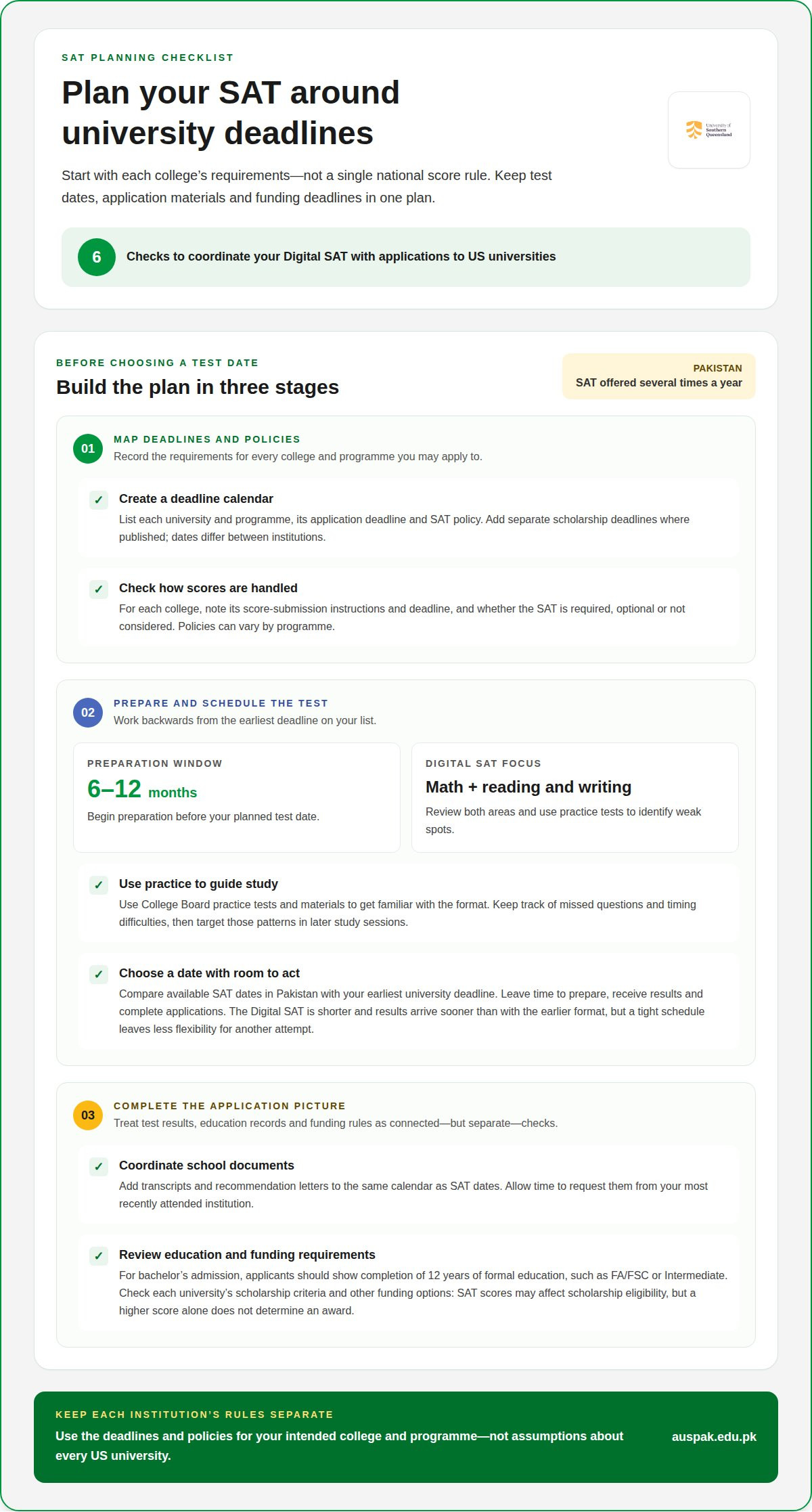
- Build a deadline calendar. List each US university and programme you may apply to, then record its application deadline and SAT policy. Include separate scholarship deadlines where published. Dates differ between institutions, so do not plan around one college’s schedule. Also note when to request transcripts and recommendation letters from your most recently attended institution.
- Begin preparation early. Start SAT preparation 6-12 months before your planned test date. This gives you time to review mathematics and evidence-based reading and writing, then address weak areas through regular practice tests. Use College Board practice tests and materials to become familiar with the test format. Keep a record of missed questions and timing difficulties, then use those patterns to guide your next study sessions.
- Choose a test date that leaves room to act. Compare SAT dates available in Pakistan with your earliest university deadline. Choose a date that allows time to prepare, receive your results, and complete applications. The Digital SAT is shorter and results are available sooner than with the earlier format, but a tight schedule still leaves less flexibility if you need another attempt.
- Check how each university receives scores. For every college on your list, find its SAT submission instructions and score deadline. Note whether the SAT is required, optional, or not considered. A score can support an application where accepted, but the university’s policy determines whether you need to submit it. Track each institution separately rather than assuming one rule applies across all US universities.
- Coordinate the test with your full application. Add school transcripts and recommendation letters to the same calendar as SAT dates. Pakistani applicants should allow time to request these documents from their most recently attended institution. For bachelor’s admission, applicants should show completion of 12 years of formal education, such as FA/FSC or Intermediate. Treat education records and test results as separate parts of your application.
- Review funding criteria before setting a score target. Check each institution’s scholarship requirements alongside its SAT policy. Some universities may use scores when assessing scholarship eligibility, while others use different criteria. A higher score does not automatically secure funding. Compare each university’s published rules, scholarship deadlines, and application requirements before deciding where to send scores.
SAT recognition at international universities
The SAT is accepted by over 4,000 universities worldwide, but recognition doesn’t mean every institution requires it. Use these steps to determine how a college’s testing policy applies to your application.
Identify accepted admissions tests
Review the admissions testing list for each university and programme before choosing a test. Pakistani students do not automatically need SAT Subject Tests or the ACT instead of the SAT. The ACT is another test applicants may need to arrange, but do not assume it replaces the SAT unless the institution’s policy says so. Match the accepted test to the specific application rather than relying on a general rule.
Compare public and private university requirements
Compare each public and private university individually; its category alone does not tell you whether the SAT is required. Check the policy for your intended programme, applicant category, and admission cycle. Note whether the institution accepts SAT results, requires them, or allows applications without them. Follow the published policy for international applicants instead of assuming all public or private colleges use the same standard.
Check university testing policies
Classify each university as test-required, test-optional, or test-blind using its current admissions instructions. At a test-required institution, plan to submit an accepted score. At a test-optional institution, decide whether a score strengthens your application and follow the submission rules. At a test-blind institution, scores are not considered in admission review. Policies can differ by programme, so record the exact rule beside each college on your list.
Explore applications without SAT scores
Check whether a university allows Pakistani students to apply without SAT scores, then identify the qualifications it considers instead. For bachelor’s admission, applicants should show completion of 12 years of formal education, such as FA/FSC or Intermediate. A-level applicants may show completion of the first year, though completing A-levels is preferable. These academic records establish education history; they don’t automatically replace a test where a university requires one.
- Separate academic testing from English proficiency. TOEFL and IELTS assess English-language proficiency, while the SAT assesses overall academic readiness. An English test result does not substitute for an SAT score when a college requires the SAT. Check each test requirement separately, including whether the university expects proof of English proficiency alongside academic qualifications.
- Use recognition as a shortlist tool. The SAT’s acceptance by over 4,000 universities worldwide can help you identify institutions where the test is relevant. It doesn’t establish that every college, programme, or country uses the same policy. For each potential destination, compare accepted tests, academic qualifications, and programme requirements before deciding which applications to prepare. Students also considering the UK can review UK study planning as a separate pathway.
Selecting colleges and researching programmes
Build your shortlist around academic fit, programme details, and application requirements. Select at least three appropriate US institutions, then compare their options before deciding where to apply.
- Create a focused shortlist. Choose at least three US institutions offering the subject you intend to study. For example, someone interested in computer science can compare universities with relevant undergraduate programmes. Record each institution’s location, programme name, and application deadline in one table. Use SAT requirements for US universities for Pakistani students as one comparison point, alongside academic fit and each college’s admissions criteria.
- Read programme pages closely. Review the official department and programme pages for each college on your shortlist. Compare course descriptions, degree structure, and stated prerequisites. A biology programme and a computer science programme may expect different academic preparation, even at the same university. Note the required subjects or coursework, then compare them with your Pakistani school record before deciding whether the programme fits.
- Match admission criteria to your profile. Make a separate checklist for every programme, since requirements can differ between institutions and departments. Record academic qualifications, required documents, English-language testing, and SAT policies. Compare SAT requirements for US universities for Pakistani students by checking the rule for each programme rather than assuming one college-wide policy covers every course.
- Compare academic fit with your interests. Use course lists to see whether a programme supports your intended direction. A student considering environmental science, for instance, can compare the study areas described by each department. Look beyond the degree title: read course summaries and departmental information, then note which options align with your interests and previous studies.
- Organise evidence for each application. Use your shortlist table to track application deadlines, transcripts, recommendation letters, and programme-specific materials. Add a status beside each requirement, such as requested, prepared, or submitted. This separates work shared across applications from documents tailored to one college. Review the table regularly and prioritise tasks tied to the earliest deadline.
- Choose a balanced final group. Revisit your options and compare academic fit, admissions criteria, and deadlines side by side. Keep programmes that match your goals and for which you can prepare a complete application. Remove options that do not suit your intended field or academic preparation. A clear comparison helps direct your effort towards suitable US colleges instead of relying on one name or ranking.
Which US universities are test-optional, test-required, or test-blind for international students?
US colleges can use different SAT policies, and a university’s category affects whether you submit scores. Classify every institution on your shortlist before finalising its application.
- Read the policy for your application cycle. Open each university’s official admissions page and find its SAT or testing section. Record the stated policy and the application cycle it covers. Do not rely on an older article or general summary; your decision needs to match the instructions for your intended admission year. Save the relevant page details alongside that college’s deadline.
- Identify test-required colleges. A test-required policy means the college expects applicants to submit accepted test scores as part of the application. Note whether the policy names the SAT, ACT, or both, and whether it covers international applicants. For example, if a university requires the SAT for first-year applicants, mark that requirement clearly. Plan your application around the listed test and submission deadline.
- Understand test-optional rules. A test-optional college allows applicants to apply without SAT scores under its stated policy. Decide whether your score adds useful evidence to your application, then follow the college’s instructions for reporting it. Optional submission does not mean scores carry no weight when submitted. Record any programme-specific instructions separately from the university-wide policy.
- Recognise test-blind policies. A test-blind college does not consider SAT scores in its admissions review under that policy. If a university describes itself as test-blind, focus on the other application materials it requests instead of sending a score for admission review. Read the exact wording: test-blind and test-optional describe different approaches. A test-optional institution may consider a submitted score, while a test-blind one does not.
- Check international applicant instructions. Look for a separate section covering international or first-year applicants, and compare it with the general testing policy. Record any stated difference for your applicant category. For example, a page may set out a general rule and then describe a separate instruction for a particular programme. Do not assume a policy applies identically to every degree or applicant type.
- Keep a policy record for each university. Add the category, accepted tests, score-submission instructions, programme notes, and application cycle to your shortlist. Revisit the official admissions page before submitting, especially if your application spans different cycles. This side-by-side record distinguishes a required SAT from an optional score or one that will not be considered. Use the university’s published wording to guide your decision.
Policies vary by university, programme, applicant type, and application cycle. Test-required colleges expect accepted scores; test-optional colleges allow applicants to apply without SAT scores and may consider scores they submit; test-blind colleges do not consider SAT scores in admissions review. Check each university’s official admissions page for its current policy.
What SAT score ranges do top US universities and colleges typically expect?
There is no single SAT score range for every US college or programme. Use each institution’s published admissions information to set a target for your shortlist.
- Find each college’s published score profile. Search the official admissions pages for SAT information for your intended application cycle. If a college shares a score range for admitted students, record the range and the group it describes. Do not treat one university’s profile as a standard for another. Use the same kind of information across your shortlist.
- Interpret the range as context, not a guarantee. A published profile describes scores among a particular group of students; it does not promise admission at a certain result. Note whether the figures refer to admitted or enrolled students, and which application period they cover. For example, a score near the lower end of a college’s stated range still needs to be considered alongside academic records and programme requirements.
- Separate university and programme expectations. Check the department page as well as the general admissions page. A university may publish broad admissions information, while a specific programme outlines additional academic expectations. Record any programme-level SAT guidance separately. This prevents a general college profile from becoming an assumed target for every course the institution offers.
- Set a practical target for each application. Compare your current practice results with each college’s published range, where available. Use the comparison to identify areas for further preparation, not to predict an admissions outcome. If your shortlist includes institutions with different profiles, set individual targets rather than choosing one score for every application. Keep each target linked to the college and programme it concerns.
- Consider the test policy before submitting scores. A score profile can guide your planning only when you understand the institution’s testing policy. If a college is test-optional, decide whether your result strengthens the application under its stated approach. If it is test-blind, focus on the application components the university considers. Record the policy beside the score information so you do not treat every profile alike.
- Review the complete application, not just the SAT. Compare your score with academic qualifications, transcripts, and programme criteria for each college. For example, an applicant may have a competitive test result but still need to show the required educational background. Use the SAT as one element in your application plan, then review how each university evaluates the other submitted materials.
If you’re also considering Australia, explore Australian study options as a separate pathway while comparing your university choices.
There is no single SAT score range for all top US universities and colleges. Use each institution’s published score profile for the relevant application cycle, and treat it as context rather than a guarantee of admission.
AusPak International: Australian University Admission Support
AusPak International supports students considering Australian universities through Australian University Admission Support. If you are comparing destinations while researching US colleges, this support can help you explore an Australian study pathway and its admission process. It is relevant when Australia is a genuine alternative, not a substitute for checking a US university’s SAT policy or application requirements.
Keep your destination decision tied to your intended programme, academic background, and application priorities. If you are weighing options across countries, AusPak International also offers UK Student Visa Consultancy and Canada Study Permit Assistance. For students who have chosen Australia, Onshore Arrival Support can help with the transition after arrival.
Contact AusPak International to discuss Australian university admission support if you are considering Australia alongside US colleges.
Turn your research into a clear next step
Your next move is to turn your college research into a decision you can act on. Treat the SAT requirements for US universities for Pakistani students as one part of a broader application decision shaped by your academic direction and the destinations you are considering. A focused plan helps you move from comparing possibilities to preparing applications with purpose.
If your plans extend beyond the United States, AusPak International can support you with Australian university admission, UK student visa consultancy, or Canada study permit assistance. Choose the destination that fits your goals, then take the next step with guidance suited to that pathway.
Contact AusPak International to discuss your study-abroad plans. Your next chapter begins with a thoughtful decision, and you can take it one step at a time.
Frequently Asked Questions
Do US universities require the SAT for Pakistani undergraduate applicants in 2026?
No, there isn’t one SAT requirement for every US university or Pakistani applicant in 2026. Each college sets its own policy, which may be test-required, test-optional, or test-blind. Check the policy for your intended programme and application cycle. Also confirm whether the rule applies to international first-year applicants, since requirements can vary by applicant category or programme.
How can Pakistani students register for the SAT and send scores to US universities?
Register through the College Board by creating an account, selecting an available SAT date and Pakistan test centre, and completing the requested details. Use the same personal information as on your identification documents. After the test, follow College Board’s score-reporting instructions to select recipient universities. Keep your score-reporting details aligned with your applications, and check each university’s instructions on whether scores are accepted or required.
What SAT policies and application deadlines should Pakistani students check for the 2026-27 admissions cycle?
For every college, check its 2026-27 admissions page for the SAT policy, application deadline, and any separate scholarship deadline. Confirm whether the policy covers international applicants and your chosen programme. Then compare the deadline with available SAT dates in Pakistan and the college’s score-submission instructions. Keep each university’s dates and requirements in a separate checklist, since institutions may set different timelines.