
The cost of living in Auckland for students depends on more than one headline figure: rent, transport and everyday spending all shape your budget.
Rent is a sensible place to start, but weekly costs vary depending on whether you choose shared housing, a private rental or student accommodation. Public transport fares and student discounts also affect how much room you have in your budget.
This guide outlines the main costs to help you plan before studying in Auckland. It covers accommodation estimates, transport fares, student discounts and New Zealand living-cost estimates, and explains the difference between a national budget and expenses specific to Auckland.
Key Takeaways
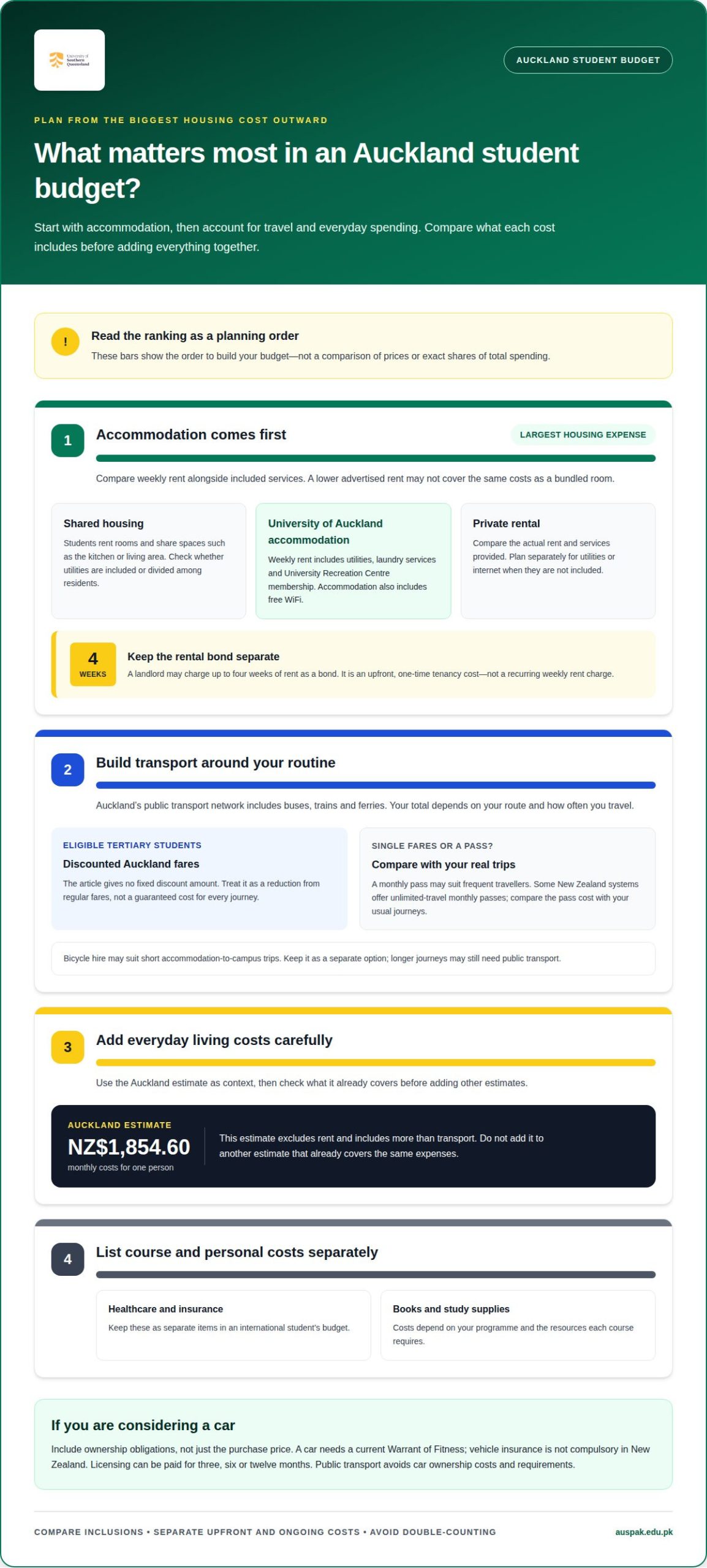
- Build your budget around housing first, then add transport and everyday expenses to see the full weekly picture.
- Compare shared housing, campus accommodation and private rentals by both rent and what is included.
- Check how your travel routine and eligibility for tertiary student fares could affect transport spending.
- Account for utilities and internet separately when they aren’t included in your accommodation costs.
- Use New Zealand-wide living-cost estimates as a starting point, then adjust your plan for Auckland’s local costs.
Is public transport expensive in Auckland?
Public transport includes the buses, trains and ferries students use to reach campus and travel around Auckland. A monthly pass may suit frequent travellers, while single fares may be more practical for occasional journeys.
Tertiary students can receive discounted Auckland public transport fares. The discount can lower the cost of regular campus travel, although your total still depends on your route and how often you travel. Some New Zealand transport systems also offer monthly passes for unlimited travel at a set price. Compare your usual journeys with the pass cost instead of assuming a pass will always save money.
University accommodation can include some living costs in the rent. At the University of Auckland, weekly accommodation rents include utilities, laundry services and a University Recreation Centre membership. Compare what is included, not just the advertised rent: a room with services bundled in may simplify budgeting, while a rental without them means planning for those costs separately.
This is a useful starting range for planning study abroad, but accommodation and personal choices shape the actual budget. For context, estimated monthly costs for one person in Auckland, excluding rent, are NZ$1,854.60. That figure includes more than transport, so don’t add it to a separate estimate covering those same expenses.
Healthcare and insurance are separate items to include in an international student’s budget.
Books and study supplies are course-related expenses, such as required texts and materials. Costs depend on your programme and the resources each course requires, so give them a separate line in your personal budget. Tertiary transport discounts can help reduce travel costs; no specific amount for other financial support is provided here.
Car ownership involves more than the purchase price, including licensing and roadworthiness requirements. Vehicle insurance isn’t compulsory in New Zealand, but cars driven on its roads must have a current Warrant of Fitness. Vehicle licensing can be paid for three, six or twelve months. Include these obligations when estimating running costs; public transport avoids the costs and requirements of car ownership.
Accommodation options and weekly rents
Accommodation is often the biggest housing expense in a student budget, and rent varies by room type and included services. Compare weekly costs alongside what each option covers instead of relying on an average alone.
Rental Bonds
A rental bond is money paid at the start of a tenancy as security for the rental agreement. In New Zealand, a landlord may charge up to four weeks of rent as a bond.
Include this upfront amount in your arrival budget, separately from weekly rent. A bond is a one-time tenancy expense, not a recurring weekly housing charge, so keep it separate when calculating ongoing costs.
Before comparing listings, record the weekly rent, bond and included services as separate budget items. This makes it easier to compare a room with shared facilities and a private apartment, and to distinguish initial move-in funds from recurring costs.
Shared Accommodation
Shared accommodation is housing where students rent rooms and share spaces such as the kitchen or living area.
These ranges are useful starting points, but they cover different things: one is a national estimate and the other is specific to Auckland. Check whether rent includes utilities, as shared-house bills may be divided among residents when charged separately.
The estimate typically includes a room, board and meals provided by the host family, so rent may cover more than the room alone. Keep mobile service and restaurant meals as separate budget items when comparing accommodation.
On-Campus and Private Accommodation
On-campus accommodation is student housing connected with a university; private accommodation is rented off campus.
University accommodation can bundle services into the rent. At the University of Auckland, accommodation includes free WiFi, utilities, laundry services and a University Recreation Centre membership. Campus accommodation move-in dates align with the university’s academic semesters, which can help you plan your arrival around your study dates.
These options differ in privacy and included services, so compare the actual package rather than rent alone. Restaurant meals and mobile plans are separate expenses, not housing costs.
Auckland public transport and student fare discounts
Auckland’s public transport network includes buses, trains and ferries. Tertiary students can get discounted fares, while total costs depend on journey distance and frequency. Budget for your regular campus commute first, then account separately for occasional trips around the city.
These figures are comparison points, not a universal student fare: eligible tertiary students can receive discounted fares. Some New Zealand public transport systems also offer monthly passes for unlimited travel at a set price. Compare your travel frequency with the pass cost before counting it as a saving.
These measures cover different periods and budget views, so don’t add them together. Use a weekly figure for a weekly plan or a monthly figure for monthly expenses.
A student fare discount is a reduced transport fare available to eligible tertiary students. The discount applies to Auckland public transport fares, but the available facts do not give a fixed discount amount. Build the benefit into your budget as a reduction from the regular fare, rather than assuming every journey has the same cost. Your travel pattern, route and use of passes affect the final total.
Personal transport options include bicycle hire as well as buses, trains and ferries. A bike may suit short journeys between your accommodation and campus, while longer trips may still require public transport. Treat bicycle hire as a separate option, not a cost every student needs to include.
The Funds Transfer Scheme is a student payment arrangement for students from China, India, the Philippines and Sri Lanka. It is not an Auckland transport discount, so keep it separate from fare reductions when planning study funds. Transport savings and funds-transfer arrangements address different expenses.
To build a practical travel budget, list regular campus journeys first, then estimate occasional trips. Compare the regular one-way fare with a monthly pass and account for any tertiary-student discount. Add bike hire only if it suits your route. Keeping rental, travel and other study costs separate makes the full budget easier to review.
Is Auckland expensive for international students?
An Auckland budget includes household bills as well as rent and groceries. Separate monthly services from annual visa funds to plan for everyday spending and your first year.
Annual Living-Funds Requirement
The annual living-funds requirement is the amount international students must show for living expenses during their first year. Student visa applicants in New Zealand must show at least NZ$20,000 for that year.
That amount is for living expenses, not tuition, so keep course fees in a separate budget line. Students applying for a visa to study school years 1-13 must show at least NZ$17,000 for first-year living expenses. These are distinct requirements for different study categories, not amounts to add together.
Use the applicable annual figure to plan your funds, then compare it with monthly costs. Electricity, internet and mobile service are recurring expenses; include rent and groceries in your wider budget too.
Electricity and Phone Expenses
Electricity and phone bills are recurring household and communication costs that may be separate from rent.
These figures cover different phone-plan options. Compare the data allowance and included calls rather than treating the plans as equivalent.
These estimates reflect different household situations and billing arrangements. Check whether utilities are included in your rent before adding a separate household estimate.
Internet and Mobile Plans
Internet and mobile plans provide home broadband and phone connectivity, and are usually separate budget items.
A shared household may split the internet bill, while a student living alone may pay the full amount. Mobile costs depend on the chosen allowance, so compare the general phone-plan range with Auckland’s estimate before setting a monthly budget.
Monthly Utilities and Internet
Monthly utilities and internet are recurring charges for household services and connectivity.
Use the combined estimate as one planning category, not as an extra charge on top of every bill listed above. For example, adding broadband, electricity and the combined estimate could count some costs twice. Make one monthly list and note which services are included in your rent.
Costs also depend on household and location, so Auckland and Wellington should not be treated as identical budgets. Keep groceries separate from utilities, then compare your monthly total with the annual living-funds requirement. This helps you review recurring bills without confusing them with upfront study funds.
New Zealand student living-cost estimates
A student living-cost estimate is a planning figure for regular expenses, separate from tuition.
How does Auckland compare with other New Zealand cities? Auckland is commonly identified as New Zealand’s most expensive city, so a national average may understate the budget needed for life in Auckland.
Annual figures offer another useful comparison, but cover a different planning period. These ranges provide context; a city estimate and a national university estimate are not identical measures.
Renting is a major factor in how closely an individual budget matches these estimates. Accommodation accounts for 40-55% of an international student’s monthly budget in New Zealand. A student sharing housing may distribute household expenses differently from someone renting privately, while included utilities can change the amount paid separately each month.
Food and groceries also shape your total. Restaurant meals can fall outside a grocery budget and add to discretionary spending.
Keep tuition separate from living costs when planning to study abroad. These are study fees, not everyday expenses.
For a practical estimate, start with the 2026 monthly student range, then adapt it to Auckland housing, food and utilities. Keep monthly costs distinct from annual tuition and first-year funds. The cost of living in Auckland for students is best understood as a budget shaped by both city-level estimates and personal choices, not one fixed amount.
AusPak International: UK Student Visa Consultancy
AusPak International provides UK Student Visa Consultancy for students preparing to study in the United Kingdom. Auckland living-cost estimates can help clarify your budget priorities, while visa planning depends on your chosen destination and study pathway.
If your plans shift from New Zealand to the UK, AusPak International can support you with UK student visa consultancy. Students considering other destinations can also access Australian University Admission Support or Canada Study Permit Assistance. Onshore Arrival Support helps students with arrival-related needs.
Choose the pathway that fits your study plans, then take the next step with focused guidance. Contact AusPak International to discuss UK Student Visa Consultancy.
Turn your study budget into a clear next step
Planning the cost of living in Auckland for students is one part of deciding where and how to study. Connect your budget with your preferred destination, programme and application timeline so your financial plan supports a practical study decision.
For other study destinations, AusPak International offers Australian University Admission Support, UK Student Visa Consultancy and Canada Study Permit Assistance. These services can help you move from exploring options to preparing the relevant application pathway. Choose the destination that fits your academic goals, then organise your next steps around that decision.
For guidance on an application pathway, contact AusPak International. Take the next step with a focused plan for your international education.
Frequently Asked Questions
How much money do I need to live in Auckland?
For a first-year plan, separate everyday spending from tuition and include initial housing costs such as a rental bond. A student sharing a home and cooking regularly will have a different budget from someone renting privately and eating out often. Use monthly estimates as a starting point, then tailor your budget to your housing and spending choices.
What is the average rent in Auckland in 2026?
There is no single rent figure for every Auckland student, because room type and location affect the cost. These are different housing categories, so compare like with like and note whether utilities are included.
What is the average monthly cost of living for a student in Auckland?
These figures cover different scopes and budgets, so they cannot predict what an individual will spend. Rent, transport, groceries and utilities can all change the total; keep tuition separate when estimating regular living expenses.
How much does student accommodation in Auckland cost per week?
Compare what each option includes, because rent alone does not show the full cost of housing.
What are typical Auckland grocery and food costs for students?
Restaurant meals add to grocery spending, so budget separately for food prepared at home and meals bought out.
What are typical monthly costs for utilities, internet, and a mobile plan in Auckland?
These figures describe different services and household situations. Students sharing housing may divide some bills, while rent may already include utilities, so avoid counting included costs twice.
What is New Zealand’s student visa minimum living-funds requirement?
International students applying for a New Zealand student visa must show at least NZ$20,000 for living expenses during their first year of study. This is a living-funds amount, separate from tuition fees, so plan for course costs independently. Applicants studying school years 1-13 have a different stated minimum of NZ$17,000 for first-year living expenses. Identify your study category before using a figure in your financial plan.