
A strong Australian university statement of purpose (SOP) isn’t a personal life story or a polished template. It explains how your experience, chosen course, and future plans fit together. If you’re working out how to write a statement of purpose for Australian university admission, focus on evidence rather than impressive sounding claims.
It’s understandable to feel uncertain: universities may set different prompts, formats, and submission instructions. An admission SOP is also not automatically the same as the Genuine Student (GS) questions in a visa application. A generic statement can leave admissions teams without a clear picture of your course fit, while an overly personal one may distract from your academic goals.
This guide will help you plan, draft, and refine a specific, authentic SOP. You’ll learn what to check in each university’s requirements, how to connect your previous study or work to your course choice, and how to support your plans with relevant examples.
We’ll also cover common drafting mistakes and a practical review process. If you want another perspective, Australian university application support can help you assess course fit and review application documents while keeping your statement truthful and personal.
Key Takeaways
- Learn how to write a statement of purpose for Australian university applications by connecting your academic evidence, course choice, and future purpose.
- Check each university’s official prompt, word limit, format, and submission method before you begin writing.
- Use a flexible structure that highlights relevant experience and course fit instead of relying on a generic template.
- Follow a practical review process to refine your draft, strengthen its evidence, and catch errors before submission.
- Prepare and verify a separate SOP for every course and institution, follow the exact submission instructions, and keep a copy.
What an Australian university statement of purpose should and should not do
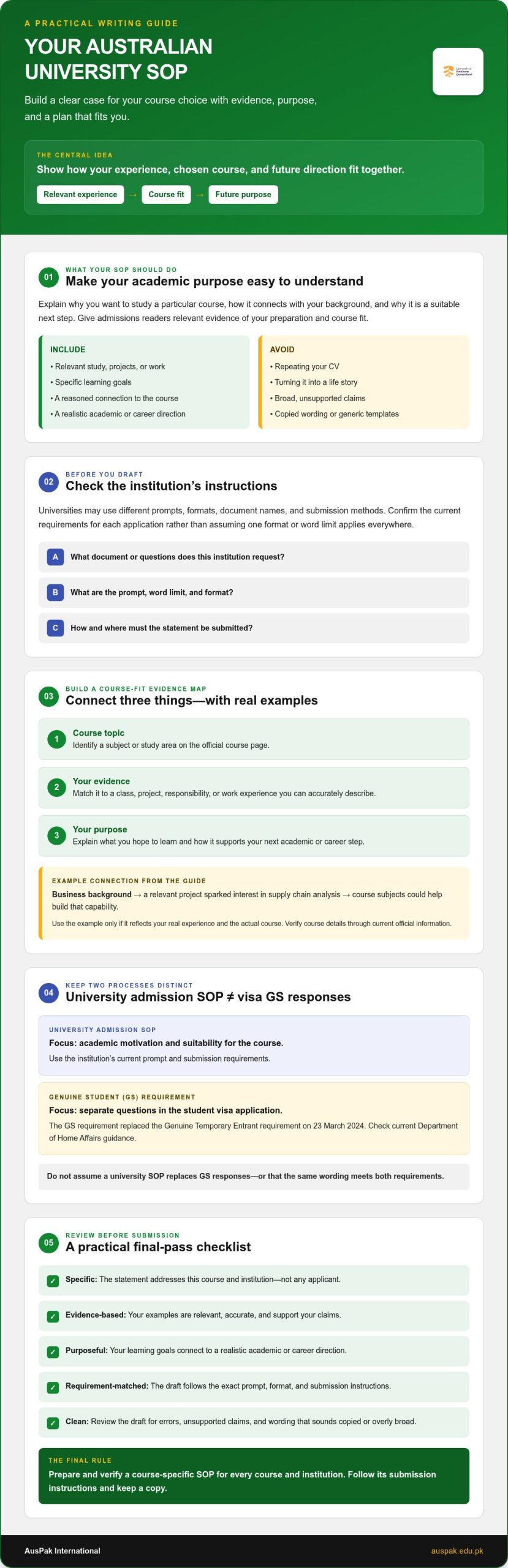
An Australian university statement of purpose is your opportunity to explain, with relevant evidence, why you want to study a particular course and how it connects with your academic background and future direction. It should help admissions readers understand your purpose, preparation, and course fit. It should not simply repeat your CV or tell your life story. A What is a Personal Statement? overview offers general context, but your university’s instructions determine what your application statement needs to contain.
In short, an SOP explains your academic purpose and course fit, and every application must follow the institution’s specific instructions. Universities may use different names for this document, set their own prompts and formats, or ask for information through an application portal rather than a separate essay. Don’t assume one format or word limit applies everywhere.
What admissions readers need to understand about your application
Make the connection between what you’ve done, what you want to learn, and why this course is a suitable next step. For example, an applicant with an undergraduate background in business might explain how an interest in supply chain analysis developed through a relevant project, then identify course subjects that would build that capability. The example should reflect your real experience and the actual course.
Be precise about your learning goals and what you hope to do with the knowledge you gain. Avoid broad claims such as “I want to be successful.” Explain what skills or subject areas you want to develop and how they relate to a realistic academic or career direction. Don’t make unsupported claims or promises about outcomes, and avoid copied wording that could describe any applicant.
An admission SOP is not a visa statement
A university admission SOP and visa related statements serve different purposes. The admission statement addresses your academic motivation and suitability for the course. Australia’s Genuine Student (GS) requirement is a separate part of the student visa process, assessed through questions in the visa application form. It replaced the Genuine Temporary Entrant requirement on 23 March 2024.
Don’t assume that a university SOP can replace GS responses, or that the same wording will meet both requirements. Check the Department of Home Affairs website for current visa guidance and follow the instructions that apply to your application. For university admission, use the institution’s current prompt and submission requirements as your guide. Keeping these tasks distinct helps you prepare each response for its intended reader.
Research the Australian course before you start writing your SOP
Build your case from the course, not from assumptions about what an admissions reader wants to hear. Before drafting, check each university’s official course page and application instructions. Requirements can vary, so a statement prepared for one application may not suit another.
Build a course fit evidence map
Use official university materials to identify course topics, learning outcomes, prerequisites, and any features relevant to your goals. Then connect each point you may mention to something real in your academic or professional background. This evidence map helps you explain not just that a course interests you, but why it makes sense for you.
- Course topic: Note a subject or area of study described on the official course page.
- Your evidence: Match it to a relevant class, project, responsibility, or work experience you can accurately describe.
- Your purpose: Explain what you hope to learn and how that knowledge supports your next academic or career step.
For instance, if a course page lists data analysis as a study area, an applicant might refer to a relevant university project and explain which analytical skills they now want to develop. Keep the connection specific and truthful. Don’t claim a university offers particular facilities, internships, rankings, or graduate outcomes unless you’ve confirmed the details in current official information.
Check the application instructions before drafting
First confirm whether the institution asks for an SOP, personal statement, responses to set questions, or another document. Record the current instructions for every application. Check the word limit, accepted file type, required questions, submission channel, and deadline. If any detail is unclear, consult the university’s official admissions information rather than relying on an old sample or a general template.
A simple application tracker can prevent avoidable errors:
- University and course name
- Document name and prompt
- Word count or response limits
- File and submission requirements
- Deadline and any course specific instructions
Applicants from Pakistan can also review this Australian university guide for Pakistani students as they plan their applications. If you’d like support reviewing course fit and application documents, explore Australian university application support. Use guidance to strengthen your research while keeping your SOP accurate and personal.
How to write a statement of purpose for Australian university applications without sounding generic
A strong SOP doesn’t depend on a fixed template or mandatory section order. Shape it around the university’s prompt and your strongest relevant evidence. For applicants asking how to write a statement of purpose for Australian university admission, the guiding principle is simple: make each claim specific, support it with a truthful example, and show why it matters for the chosen course.
Keep the writing clear rather than ornate. Admissions readers need to follow your reasoning, not decode elaborate language. A flexible beginning, middle, and conclusion can help you organise that reasoning, but adjust the structure to suit the application instructions.
Create a clear beginning, middle, and conclusion
Beginning: State your academic direction and the course you’re applying for, then briefly introduce why it is a suitable next step. Middle: Connect relevant study, projects, employment, or other experience to the preparation and interests you bring. Conclusion: Summarise what you hope to learn and how it supports your academic or career aims. Follow the university’s prompt if it asks for a different order or specific responses.
Replace broad claims with relevant evidence
“I am passionate about business” tells the reader little on its own. A more useful explanation might refer to a real coursework project, describe the question or skill that held your interest, and connect that experience to a relevant area of the proposed course. Include employment or volunteering only when it genuinely supports your case. Explain what each example demonstrates, such as preparation for a subject area or a clear learning goal.
Use this comparison to test whether a paragraph is doing enough:
| Claim | Supporting evidence | Course connection | Reader value |
|---|---|---|---|
| “I’m passionate about data analysis.” | A relevant class project using data to answer a defined question. | Names a course topic, verified in the university’s current materials, that builds on the project. | Shows a genuine interest, relevant preparation, and a reason for applying. |
| “This course is an excellent choice.” | No example or detail is provided. | No specific link to the course is explained. | Offers little basis for judging course fit. |
Before keeping a sentence, ask: Is the claim accurate? Does the example prove something relevant? Have I explained its connection to this course? If the answer is no, revise or remove it. Your own truthful details will make the statement distinctive. Polished wording can’t replace them.
Draft and edit your SOP with a step by step review process
A useful draft starts with clear answers, not polished paragraphs. If you’re working out how to write a statement of purpose for Australian university admission, use this sequence to keep your response focused, accurate, and specific to the application.
- Break down the prompt. Note each question or requirement, the word limit, and any formatting instructions. Mark what the university needs to learn from your response.
- Write short notes first. Jot down relevant study, projects, employment, or other experience that answers the prompt. Keep only examples that support your academic direction and course choice.
- Build the connection. Arrange your notes so the reader can follow how your past preparation leads to this proposed study. Add transitions that explain the link rather than expecting the reader to infer it.
- Draft in your own voice. Turn the notes into paragraphs, then check that each one serves a clear purpose and answers the prompt.
- Verify and proofread. Compare every factual detail with your transcripts and application documents. Check names, dates, qualifications, roles, and project details before submitting.
Draft from notes before polishing the prose
Resist the urge to perfect the opening sentence before you know what the whole SOP needs to say. First, answer the university’s prompt in plain language. Then select the examples that best demonstrate your preparation and interest. A short planning note might connect a relevant course project to a subject area in the proposed degree, followed by a sentence explaining what you want to learn next.
Use this as a test of the statement’s central logic: A strong SOP links evidence from your experience to course fit and a clear academic purpose. If a paragraph doesn’t contribute to that link or answer a prompt, revise it or remove it.
Review clarity, accuracy, and originality
Make separate editing passes instead of trying to catch everything at once. First check prompt coverage and the word limit. Next, confirm the institution’s name and course title. Then remove repeated ideas, unsupported claims, copied wording, and personal details that don’t help explain your academic purpose. Read the final version aloud to spot awkward phrasing and unclear transitions.
Ask a trusted reader for feedback on clarity, but keep the story yours. They can flag gaps or confusing passages; they shouldn’t invent experiences or change your goals. For further guidance on preparing application documents, see university application assistance guidance. If you’d like support reviewing your Australian university application documents, explore Australian university admission support.
Prepare a course specific final SOP and plan your next application steps
Your final statement should be tailored to the course and institution you’re applying to, not copied unchanged across applications. Keep a separate version for each one, even if the courses are similar. A changed prompt, course title, or submission format can affect what belongs in the SOP. If you’re considering how to write a statement of purpose for Australian university applications, make your last review a comparison against the latest instructions, not just a spellcheck.
Use a final pre submission checklist
Before uploading, open the university’s current application instructions and confirm the document still meets them. Check the course details and compare factual claims with your academic records, CV, and other submitted materials. Small inconsistencies, such as different dates or qualification names, can create confusion. Keep a copy of the final file and record which version went to each institution.
- Confirm the latest prompt, word limit, course title, and institution name.
- Check the required file format, upload location, and any specific submission directions.
- Verify academic details against transcripts and other application documents.
- Save a clearly labelled copy for each course and note the version submitted.
Submit only after the statement reflects your own experience and follows the university’s instructions. Don’t assume a document sent for one application can be reused without checking it carefully.
Know when application support can help
If you’re uncertain about course fit or how to prepare supporting documents, a profile review can help you identify questions to resolve before submission. AusPak International supports Pakistani students with Australian university application processing, document verification, and submission guidance for partner universities. Advisers can help review your application, but your SOP should remain truthful and personal. Support can guide preparation; it can’t promise admission or visa approval.
For applicants who would value help with the next steps, discuss Australian university application support. Bring your course preferences and available academic documents to the conversation so you can clarify what needs attention. University application support and visa documentation guidance are separate, so check which kind of assistance is relevant to your current stage.
Make your next SOP application ready
A convincing SOP is specific to the course, grounded in your real academic or professional experience, and shaped by the university’s current instructions. As you consider how to write a statement of purpose for Australian university admission, keep the central link clear: what you’ve done, what you want to learn, and why this course supports your direction.
Before submitting, check the prompt, course details, word limit, and factual consistency with your other application documents. Prepare a separate, carefully reviewed version for every institution. Your statement should remain genuinely yours, even if you seek guidance along the way.
AusPak International supports application processing, profile assessment, document verification, and submission guidance. It partners with more than 40 Australian universities. If you’d like to discuss your application and document preparation, discuss your Australian university application with AusPak.
Take the next step with a clear plan and a statement that reflects your goals. Your application journey starts with making your case thoughtfully and truthfully.
Frequently Asked Questions
Is a statement of purpose required for every Australian university?
No, Australian universities don’t all require a statement of purpose. Requirements can vary by university, course, applicant, and application pathway. Some ask for an SOP or personal statement, others provide specific questions, and some may not request one. Before drafting, check the current course and application instructions. If a statement is required, follow its exact prompt, format, and word limit instead of assuming another institution’s rules apply.
How long should a statement of purpose for an Australian university be?
There’s no single word count for every Australian university or course. Follow the limit stated in the application portal or official instructions, including any per question limits. If no length is specified, keep your statement concise and focused on the requested points. Don’t add unrelated details to make it longer. Before submitting, check that the final document meets the institution’s current length and format requirements.
Can I use the same SOP for multiple Australian universities?
Use your core academic story as a starting point, but don’t submit an unchanged SOP to every university. Tailor each version to the institution’s prompt and the specific course, explaining why it suits your background and goals. Check the university and course names, along with any examples that need to be relevant. A separate review for each application helps prevent errors and keeps your statement focused.
What should I include in an Australian university SOP?
Start by answering the university’s prompt. Depending on its instructions, explain your academic background, relevant experience, reasons for choosing the course, and future academic or professional aims. Support key points with truthful examples, such as relevant coursework or a project, and connect them to your purpose for applying. Keep claims consistent with your other application documents, and don’t add sections the university hasn’t requested.
Is an SOP the same as the Genuine Student requirement statement?
No. A university admissions SOP and information requested for Australia’s visa process serve different purposes, so don’t assume one replaces the other. Universities set their own admissions requirements, while visa requirements are determined separately and may change. Follow the instructions for the specific university statement, and check the Australian Department of Home Affairs for current visa guidance. Keep each response accurate and prepared for its intended purpose.
Can an education consultant write my statement of purpose for me?
An adviser can help you understand application instructions, organise your evidence, or review clarity and consistency, but your statement should accurately reflect your own experience, intentions, and voice. Don’t include invented achievements or claims. Ask what support is provided, then review the final document carefully before submission. Application assistance can help with preparation, but it can’t guarantee university admission or visa approval.