What if the perceived gap between your FSc results and an international degree is actually a bridge waiting for you to cross? For many students, the transition from local colleges to a global campus feels like a maze of financial hurdles and confusing entry requirements. You likely feel the pressure of choosing between a Foundation Year and Direct Entry; you might even fear that a single documentation error could lead to a visa rejection. It is a common anxiety for those looking to study abroad after intermediate Pakistan. With Australia now requiring AUD 29,710 for living costs and Canada’s GIC reaching CAD 20,635, the stakes for Pakistani families have never been higher.
This guide simplifies that complexity. It provides a definitive roadmap for FSc, ICS, and A-Level students by breaking down every critical step of the application process. You’ll discover how to align your academic stream with the right international pathway and master the 2026 visa regulations. We will examine scholarship eligibility, compare top destinations like the UK and Australia, and outline the exact steps to secure your future at a world-class institution. Your global journey starts here.
Key Takeaways
- Understand why 2026 represents a significant shift for Pakistani students as more global institutions formalize recognition of local board results.
- Determine whether an International Foundation Programme or Direct Entry is the optimal bridge for your specific FSc or A-Level results.
- Explore the premier advantages of Australia and the UK, including post-study work opportunities and streamlined admission processes.
- Secure your transition by mastering the essential documentation required to study abroad after intermediate Pakistan without facing visa complications.
- Learn how professional consultancy acts as a “Trusted Navigator” to transform complex legal and academic requirements into a manageable, successful roadmap.
The Landscape of International Education After Intermediate
Choosing to study abroad after intermediate Pakistan is a strategic pivot toward global competitiveness. Completing 12 years of Education in Pakistan equips you with technical knowledge, but an international degree adds the cultural fluency required by modern employers. In 2026, the landscape is more welcoming than ever. Many prestigious institutions have updated their entry criteria to better accommodate Pakistani board students. This shift means your FSc or ICS marks carry more weight than they did five years ago. While the “Big Three”, Australia, the UK, and Canada, dominate the conversation, diverse options in Germany and Turkey are gaining traction due to their specialized research facilities and affordable tuition structures.
FSc vs. A-Levels: How Universities View Your Credentials
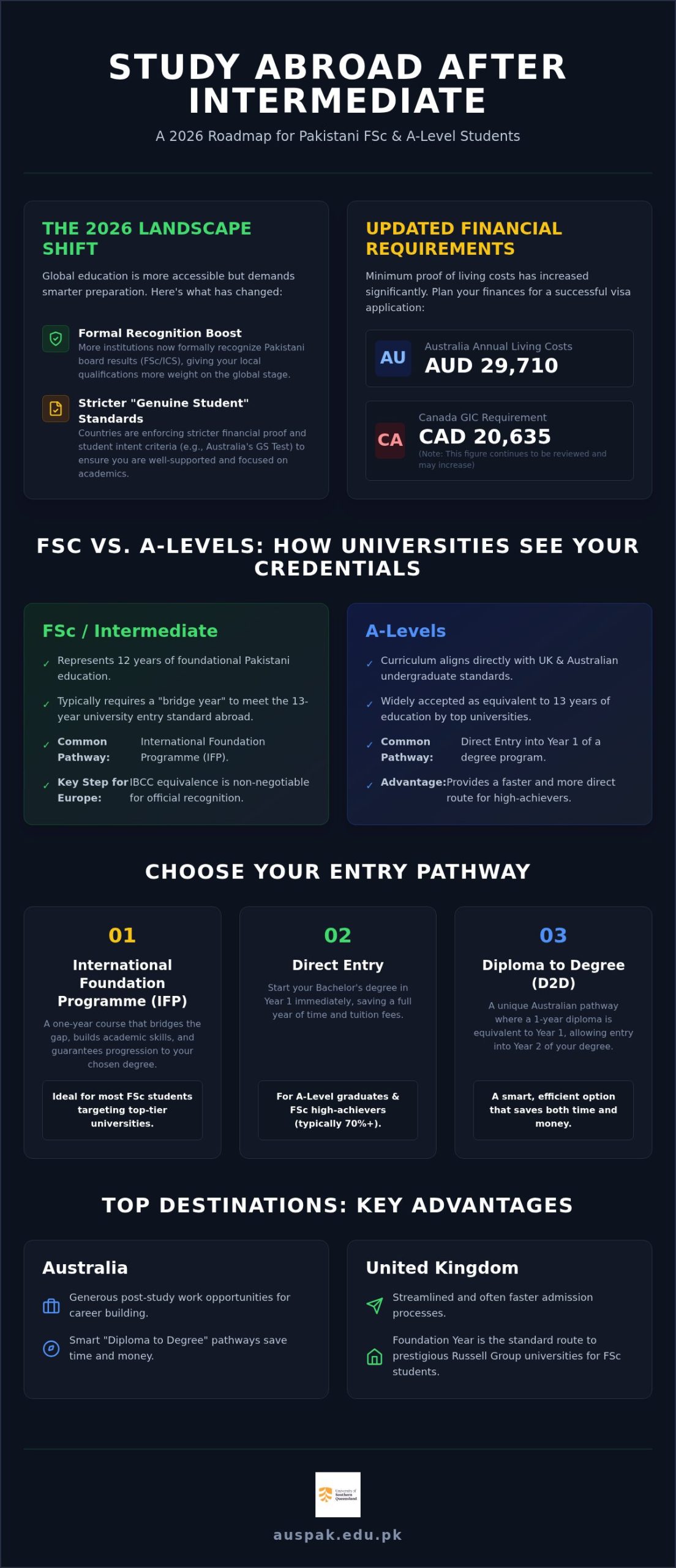
Academic credentials are the first gatekeeper in your journey. A-Level students often secure direct admission because their curriculum mirrors the undergraduate entry standards of the UK and Australia. FSc Pre-Medical and Engineering students, however, usually enter through an International Foundation Programme. This bridge year provides the necessary 13th year of schooling required by many global systems. It’s an opportunity to refine your academic writing and research skills before starting your full degree. For those targeting Europe, securing IBCC equivalence remains a non-negotiable step to ensure your local marks are officially recognized by foreign ministries.
The 2026 Outlook for Pakistani Students
The 2026 application cycle is defined by stricter financial and “genuine student” standards. Australia now requires proof of AUD 29,710 for living costs, and Canada has increased its living cost requirement to CAD 23,448 for late 2026 applicants. These figures reflect a global push toward ensuring students are well-supported during their stay. Policy changes like Australia’s Genuine Student (GS) test have replaced the older GTE system, creating a more structured evaluation of your academic intent. To study abroad after intermediate Pakistan successfully, you must adopt a “Global Student” mindset. This means viewing your undergraduate years as the launchpad for an international career rather than just a period of academic study. Success today depends on early preparation and a clear understanding of these evolving regulatory frameworks.
Entry Pathways: Foundation Year vs. Direct Admission
Choosing the right route to study abroad after intermediate Pakistan depends entirely on your academic background and career goals. Students from the Pakistani board system typically complete 12 years of education, while many international universities require 13 years for undergraduate entry. This creates two distinct pathways: the International Foundation Programme (IFP) and Direct Admission. The IFP acts as a critical bridge, providing the extra year of study needed to align with global standards. In contrast, direct admission allows high achievers to skip the preparatory year and start their degree immediately. Local students are increasingly reshaping global mobility by strategically using these pathways to enter top-tier institutions.
While the foundation year adds an extra year to your timeline, it often results in better long-term academic performance. Direct entry is faster but requires exceptional marks, often 70% or higher from your respective BISE. Australia offers a unique middle ground called the “Diploma to Degree” (D2D) pathway. In this model, you complete a one-year diploma that is equivalent to the first year of a bachelor’s degree. Upon successful completion, you transition directly into the second year of your university program. This saves both time and money without compromising on the quality of your education.
When is a Foundation Year Mandatory?
For students targeting the UK’s Russell Group or Australia’s Group of Eight, a foundation year is frequently mandatory for FSc holders. These elite institutions use this period to ensure you’ve mastered academic writing and specific subject prerequisites. It isn’t just about meeting a requirement; it’s about survival. The rigors of a foreign bachelor’s degree can be overwhelming without this transition period. You’ll gain confidence in your English proficiency and learn how to navigate complex university systems before the pressure of degree-level grading begins.
Direct Entry Opportunities for High Achievers
Direct entry is not impossible for FSc students. Destinations like Malaysia and certain universities in Europe often accept 12 years of education if your marks are high enough. In the United States, strong SAT or ACT scores can help you bypass foundation requirements entirely. Most major Pakistani boards (BISE) require a minimum 70% to 80% threshold for these opportunities. If you’re unsure which category your marks fall into, you can consult with an admission specialist to explore your specific eligibility for 2026 intakes.
Top Destinations for Pakistani Students in 2026
Deciding where to study abroad after intermediate Pakistan involves balancing academic prestige with practical career outcomes. While traditional giants like the United States offer unparalleled research facilities through organizations like the United States Educational Foundation in Pakistan (USEFP), other nations have tailored their 2026 policies to attract undergraduate talent. From the tuition-free public universities in Germany to the robust post-study work streams in Australia, each destination offers a unique value proposition for FSc and A-Level graduates. Success requires a strategic choice.
Why Australia Remains a Top Choice
Australia continues to lead the market. This preference is driven by the high standard of living and the transparency of the Simplified Student Visa Framework (SSVF). For a detailed breakdown of costs and rankings, consult our Australia University Guide 2026 for Pakistani Students. Success in Australia often depends on having local support; our unique onshore office in Melbourne provides students with a safety net upon arrival. With the 2026 living cost requirement set at AUD 29,710, the financial commitment is significant. However, the return on investment through world-class education and post-study work rights remains unmatched.
The UK and Canada: Alternative Powerhouses
The United Kingdom remains a favorite due to its academic flexibility and the Graduate Route visa, which allows students to gain work experience immediately after finishing their degree. The UK application fee for 2026 is £558, making it a competitive entry point for those seeking accelerated three-year degrees. Canada, meanwhile, attracts those focused on long-term residency. The Student Direct Stream (SDS) remains the most efficient processing route for Pakistani applicants, requiring a GIC of CAD 20,635. For a step-by-step walkthrough of the latest requirements, view the Canada Study Permit from Pakistan: 2026 Guide. Both nations offer diverse campus lives that help students from Pakistan integrate quickly into global society.
Europe has emerged as a formidable contender for students seeking affordability without sacrificing quality. Germany is particularly popular, requiring a blocked account of €11,904 for the first year, which allows for monthly withdrawals of €992 to cover living expenses. Hungary and Finland also offer a growing number of English-taught programs in engineering and social sciences. These destinations provide a gateway to the broader Schengen area, expanding your professional network across the continent. Choosing between these powerhouses requires a clear understanding of your financial capacity and your ultimate career destination. It’s about your future.
Admission Requirements & Visa Documentation
Securing an offer letter is only the first stage of your transition. To successfully study abroad after intermediate Pakistan, you must compile a bulletproof documentation package that satisfies both university registrars and visa officers. Your academic portfolio must include verified transcripts and, if your final results are pending, a Hope Certificate issued by your college principal. Letters of recommendation from faculty members who can vouch for your academic rigor are equally vital. Your financial evidence must be beyond reproach. For Australia, you’ll need to demonstrate access to AUD 29,710 for living costs, while Canada requires CAD 23,448. You must prove the “Source of Income” for these funds, providing a clear, documented history of how the money was accumulated over the last three to six months.
Mastering the GTE/GS Requirement
The “Genuine Student” (GS) test has become the primary filter for Pakistani applicants in 2026. This assessment determines whether your primary motivation is a high-quality education or simply a gateway to the local labor market. The Genuine Student requirement is a measure of a student’s intent to study and return to their home country upon completion. For those targeting the southern hemisphere, understanding the GTE Requirements for Australian Student Visa Explained is essential for avoiding a refusal. Our counselors act as your navigator through this subjective process, ensuring your Statement of Purpose (SOP) aligns perfectly with official expectations.
IELTS and Standardized Testing
Language proficiency remains a non-negotiable prerequisite for entry. Most foundation programs require an IELTS band of 5.5, while direct bachelor’s entry typically demands a 6.0 or 6.5 minimum. If you’ve completed A-Levels with high grades in English, you might be eligible for an exemption, but most FSc students will need a formal test result. Don’t leave your success to chance. We offer a Free IELTS Mock Test to help you identify your strengths and weaknesses before you pay the official registration fee. This diagnostic tool is the first step in ensuring your application meets the high standards of global universities.
Ready to begin your documentation? Book a professional document review session with our expert consultants today.
How Professional Consultancy Ensures Success
Attempting to study abroad after intermediate Pakistan without expert guidance is like navigating a complex legal system without a qualified advocate. The stakes are high; a single oversight in your financial documentation or a poorly articulated Statement of Purpose can lead to a visa refusal that impacts your future travel prospects. A professional consultant acts as a “Trusted Navigator,” transforming a daunting bureaucratic maze into a clear, sequential roadmap. Our role in University Application and Admission Processing goes far beyond simple data entry. We strategically align your academic strengths with the specific prerequisites of over 40 Australian university partners, ensuring you apply to institutions where you have the highest probability of success.
Our Visa Consultancy and Documentation Service is built on nearly 30 years of institutional knowledge. Since 1995, we’ve mastered the nuances of evolving regulations, including the transition from GTE to the new Genuine Student (GS) test. We don’t just tell you which documents to collect; we scrutinize every bank statement and affidavit for compliance with 2026 standards. This meticulous approach minimizes risk and provides the professional authority required to handle high-stakes international transitions.
From Pakistan to Melbourne: Continuous Support
Most consultants disappear the moment your visa is stamped. We believe your journey is just beginning at that point. Our unique onshore office in Melbourne provides a critical advantage that no other firm in Pakistan can match. This local presence means you have access to arrival support, accommodation assistance, and orientation sessions led by people who understand both Pakistani culture and the Australian environment. We help students transition into the local job market by providing insights into workplace norms and networking. For parents, this provides immense peace of mind. Knowing there is a local guardian and a physical office your child can visit in Australia reduces the anxiety associated with such a significant life change.
Choosing the Right Consultant in 2026
The quality of your consultant directly correlates to the quality of your university placement. In 2026, you should prioritize firms with at least 30 years of experience and direct, official partnerships with global institutions. These direct links often lead to faster processing times and clearer communication regarding scholarship eligibility. You can find more details in our Best Study Abroad Consultants in Pakistan: A Comprehensive 2026 Guide. Don’t wait for your final transcripts to arrive. Start your profile assessment early to beat the competitive intake deadlines. Take the first step toward your global career today. Your future self will thank you for the head start.
Secure Your Academic Future on the Global Stage
Navigating the transition to study abroad after intermediate Pakistan requires more than just academic merit; it demands a strategic understanding of evolving 2026 visa regulations and university entry pathways. Whether you’re entering through a foundation year or qualifying for direct admission, the decisions you make today will define your professional trajectory for years to come. You’ve learned how to decode the Genuine Student test and identified the premier destinations that offer the best return on your investment.
Success in this complex environment is best achieved with a mentor who has mastered the system. With 30 years of excellence and official partnerships with 40+ Australian universities, AusPak International provides the institutional expertise you need. Our onshore office in Melbourne ensures you’re never alone, providing local support long after you land. Don’t leave your dreams to chance. Book Your Free Consultation with AusPak International Today and take the first definitive step toward your international degree. Your global journey is ready to begin.
Frequently Asked Questions
Can I study abroad after Intermediate with 50% marks?
Yes, you can secure an international education even with 50% marks, though your options for direct entry into top-tier universities will be limited. Most students in this bracket successfully transition through a Foundation Year or by applying to institutions in destinations like Malaysia, Hungary, or Turkey. These pathways are designed to bridge the academic gap, allowing you to prove your capabilities before starting a full degree program abroad.
Which country is best for Pakistani students after FSc in 2026?
Australia remains the premier choice for FSc graduates due to its robust post-study work streams and the high standard of living. The UK is another excellent contender, offering unparalleled flexibility through its International Foundation Programmes. For those prioritizing affordability, Germany is a leading destination because of its tuition-free public universities. The “best” country ultimately depends on your specific career goals and your family’s financial capacity for the upcoming year.
Is IELTS mandatory for study abroad after Intermediate?
Generally, a language proficiency test is mandatory for most English-speaking destinations. While some A-Level students with high English grades may qualify for waivers, FSc and ICS students almost always need an IELTS, PTE, or TOEFL score. To ensure you are ready for the official exam, you can take a Free IELTS Mock Test with us. This diagnostic tool helps you identify your current level and ensures your application meets global standards.
What is the total cost of studying abroad from Pakistan after 12th?
The total investment to study abroad after intermediate Pakistan varies by country. For 2026, Australia requires proof of AUD 29,710 for living costs, while Canada’s requirement is CAD 23,448. Tuition fees generally range from $15,000 to $35,000 per year at most universities. While European options like Germany offer lower tuition, you must still provide €11,904 in a blocked account to cover your first year of living expenses in the country.
Can I work while studying abroad as a Pakistani student?
Most popular study destinations allow international students to work part-time to support their living expenses. In Australia, students can typically work up to 48 hours per fortnight during the semester and unlimited hours during scheduled breaks. The UK and Canada offer similar opportunities, usually capping work at 20 hours per week during term time. This experience is invaluable for building a professional network, though it should not be your primary source for tuition.
What is a Foundation Year and do I really need it?
A Foundation Year is a preparatory course that provides the 13th year of education required by many international universities. Since the Pakistani intermediate system concludes after 12 years, this bridge is often necessary for FSc or ICS students to meet undergraduate entry standards. It focuses on academic English, research skills, and core subjects related to your intended degree. Completing this year significantly improves your chances of succeeding in a rigorous bachelor’s program.
How long does the student visa process take from Pakistan?
The timeline for a student visa varies significantly depending on the destination and the time of year. Generally, you should begin the process at least four to six months before your intended intake. Australia and the UK often process visas within four to eight weeks, while Canada can take three months or more. Using a professional consultant ensures your documentation is correct from the start, which helps avoid the delays that lead to missed deadlines.
Are there fully funded scholarships for Pakistani students after Intermediate?
Fully funded undergraduate scholarships are exceptionally competitive but do exist for high achievers. Programs like the Commonwealth Scholarships or specific university merit awards can cover both tuition and living costs. Most Pakistani students qualify for partial scholarships, which typically range from 10% to 50% of the tuition fee. These awards are based on your intermediate marks and your performance in standardized tests, making early application and strong academic results crucial for success.