
Did you know that student visa grants for Pakistani nationals recently dropped to just 4,978 in a single year? This contraction reflects a rigorous new era of Australian immigration, where even minor documentation gaps lead to immediate refusals. You’re likely feeling the sting of lost university fees and the fear that your international career has stalled before it truly began. It’s exhausting to face technical jargon when you’re searching for what to do after Australian visa rejection. We understand that a refusal feels final, but it’s actually a forensic opportunity to audit your profile against 2026 compliance standards.
This guide explains exactly how to pivot from a setback toward a successful outcome. You’ll learn to navigate the Administrative Review Tribunal (ART) transition, master the Genuine Student (GS) requirements, and rebuild your financial paper trail with precision. We’ll outline a methodical roadmap to help you evaluate whether to appeal or reapply, ensuring your next submission is professionally structured and legally sound. Your dream of studying in Australia remains attainable; you simply need a more calculated strategy to secure your future.
Key Takeaways
- Learn to decode the technical language in your refusal letter to distinguish between mandatory document failures and discretionary officer decisions.
- Master the 2026 Genuine Student (GS) framework to ensure your next application provides undeniable proof of your educational intent and financial history.
- Evaluate the strategic benefits of an Administrative Review Tribunal (ART) appeal compared to the speed and control of lodging a fresh offshore application.
- Discover exactly what to do after Australian visa rejection by following a forensic audit process that identifies and neutralizes previous documentation risks.
- Identify how professional profile assessments can align your student visa strategy with the latest 2026 compliance standards and university requirements.
Decoding Your Australian Visa Refusal Letter
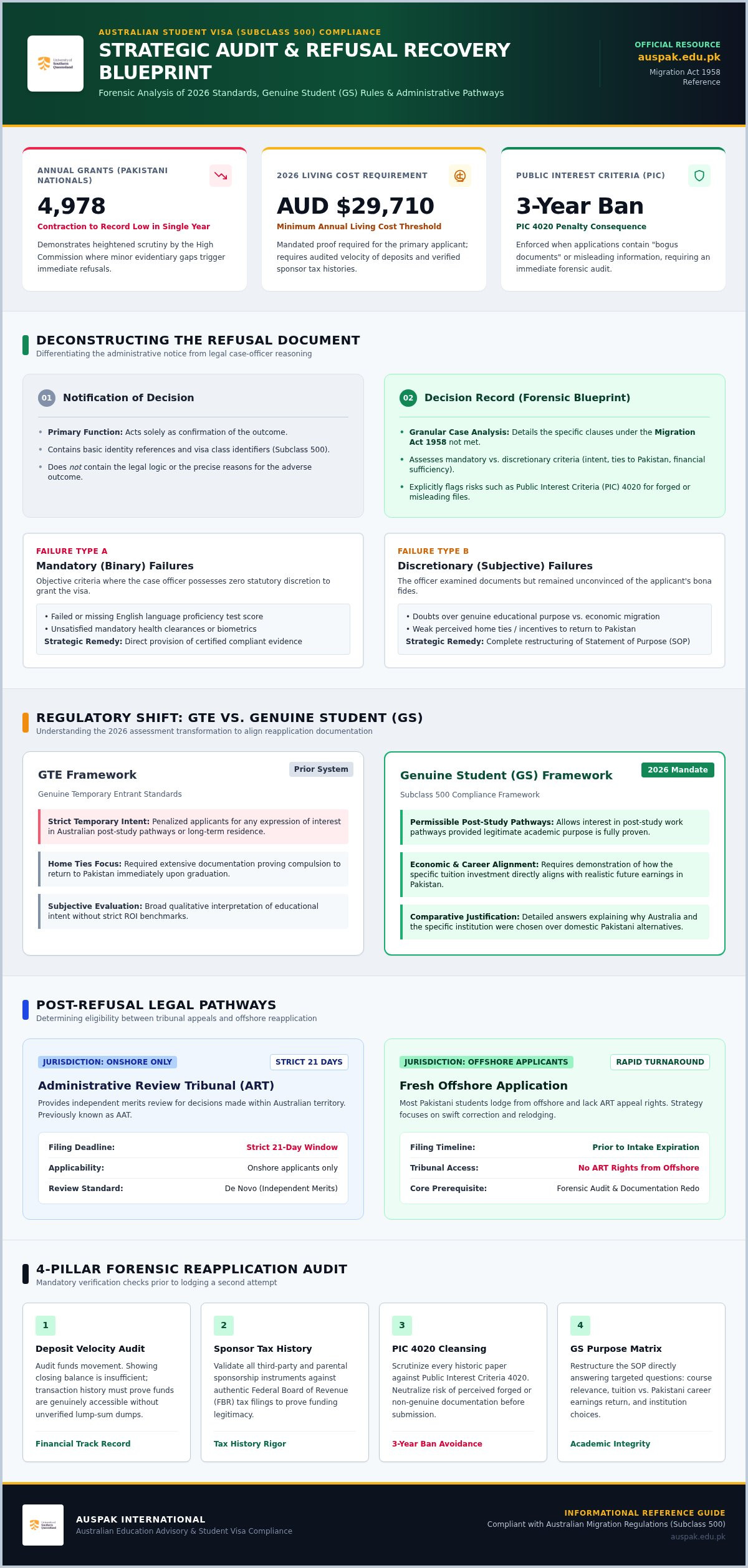
Your refusal letter is more than just a rejection; it’s a technical blueprint of where your application failed to meet 2026 standards. To understand what to do after Australian visa rejection, you must first separate the “Notification of Decision” from the “Decision Record.” While the notification confirms the outcome, the Decision Record contains the case officer’s granular reasoning. It identifies which specific clauses of the Migration Act 1958 were not satisfied. Most Pakistani students find their refusals tied to Subclass 500 criteria, specifically regarding financial capacity or the Genuine Student (GS) requirement.
Distinguishing between mandatory and discretionary failures is your next priority. Mandatory failures are binary; if you failed to provide a valid health clearance or a required English language test score, the officer had no choice but to refuse. Discretionary decisions are more complex. These occur when an officer acknowledges your documents but remains unconvinced of your intent. Understanding this distinction allows you to determine if you need to provide a missing document or if you must completely rewrite your statement of purpose to address subjective concerns about your ties to Pakistan.
Understanding the Legal Basis of Refusal
The Decision Record often cites Public Interest Criteria (PIC) 4020, which is a high-stakes clause involving “bogus documents” or misleading information. If your letter mentions PIC 4020, you face a potential three-year re-entry ban, making a forensic audit of your previous submission mandatory. In 2026, migration officers apply the Migration Act 1958 with heightened scrutiny on third-party financial instruments. They don’t just look at the balance; they audit the velocity of deposits and the tax history of your sponsors to ensure the funds are genuinely available for your education.
Critical Timelines You Cannot Miss
Time is your most scarce resource once a refusal is issued. If you applied while onshore, you typically have a strict 21-day window to lodge an application with the Administrative Review Tribunal for a merits review. However, most Pakistani applicants applying from home are offshore and don’t have these tribunal rights. For offshore cases, what to do after Australian visa rejection involves a rapid assessment of whether to lodge a fresh application before your university’s intake deadline passes. Missing an appeal or re-application deadline usually makes the decision final, leaving a permanent mark on your immigration record. Act immediately to preserve your future options.
Analyzing Common Rejection Grounds for Pakistani Applicants
Identifying the specific catalyst for your refusal is the primary step in deciding what to do after Australian visa rejection. For Pakistani students, the level of scrutiny applied by the High Commission has reached unprecedented levels in 2026. Rejections rarely stem from a single error; instead, they’re often a combination of perceived financial instability, academic inconsistency, or a failure to meet the rigorous new Genuine Student standards. You must analyze your Decision Record to see if the officer questioned your incentives to remain in Pakistan or your potential for career advancement after graduation.
The Genuine Student (GS) Requirement in 2026
The transition from the Genuine Temporary Entrant (GTE) system to the GS framework represents a fundamental change in how applications are assessed. Unlike the old system, which penalized students for any hint of long-term migration interest, the GS requirement permits post-study pathway interest as long as the student demonstrates a legitimate academic purpose. Case officers now ask targeted questions about why a student is choosing Australia over Pakistan and how the specific tuition investment aligns with future earnings. You should review the GTE Requirements for Australian Student Visa Explained to see how these criteria have evolved and how to articulate your educational journey more effectively.
Financial and Academic Discrepancies
Financial grounds remain a leading cause of refusal for Pakistani applicants. In 2026, the Department of Home Affairs requires proof of a minimum annual living cost of AUD $29,710 for the primary applicant. Simply showing this balance is no longer sufficient. Officers actively audit the velocity of deposits and require clear tax documentation for all sponsors. When reviewing the ART immigration decision review guidelines, it’s clear that many refusals occur because of untraceable funds or lump-sum deposits that lack a documented source. Using unverified agents who suggest arranging bank statements is a high-risk move that often triggers a PIC 4020 ban.
Academic progression and English proficiency are equally critical factors. A significant study gap without a documented work history or a low IELTS score below the required threshold for your specific subclass are immediate red flags. If you’ve changed your field of study, you must provide a compelling narrative explaining the relevance of this shift to the Pakistani job market. Our specialists can help you bridge these gaps through expert visa documentation services that align your profile with current compliance benchmarks.
Strategic Options: AAT/ART Appeals vs. Fresh Applications
Deciding what to do after Australian visa rejection requires a cold, analytical look at your refusal grounds. You’re essentially choosing between a legal challenge and a tactical reset. For most Pakistani students, the choice isn’t just about cost; it’s about time and jurisdiction. The Administrative Review Tribunal (ART) has replaced the AAT as of late 2024, providing a new framework for merits review. However, this path isn’t open to everyone, and understanding your eligibility is the first step in your recovery strategy.
The Appeal Process (Administrative Review Tribunal)
The most critical fact for Pakistani applicants is that offshore student visa refusals generally do not have merits review rights. If you applied from Pakistan and were refused, you cannot typically appeal to the ART. Merits review is largely reserved for onshore applicants who were physically in Australia at the time of their application and refusal. For those who are eligible, the Department of Home Affairs review of decisions guidelines confirm a standard application fee of AUD $3,727 as of July 2026. While a 50% fee reduction exists for proven financial hardship, the timeline is the greater deterrent. ART data shows that 95% of migration reviews can take up to 2 years and 10 months to resolve. A negative tribunal decision can also complicate future travel by affirming the original refusal on legal grounds.
When to Start a Fresh Application
In many cases, lodging a fresh application is the superior strategy. This is especially true for offshore Pakistani students who lack appeal rights or those whose refusal was based on easily fixable documentation errors, such as outdated bank statements or a weak Statement of Purpose (SOP). A new application allows you to address the case officer’s concerns directly with fresh, objective evidence. You must be transparent about your previous refusal in your new SOP. Explain what has changed and why you now meet the Genuine Student (GS) criteria. Using these Australian Student Visa: Tips for a Successful Application can help you restructure your profile to avoid repeating past mistakes. If your previous refusal was due to a lack of course relevance, switching to a higher-ranked university or a more logical academic progression can significantly improve your grant prospects.
- Audit your previous file: Identify if the refusal was mandatory (e.g., failed English test) or discretionary (e.g., officer wasn’t convinced of your ties to Pakistan).
- Assess the Section 48 Bar: If you’re onshore, a refusal may trigger a Section 48 bar, preventing you from lodging most other visa types while in Australia.
- Verify your sponsors: Ensure all financial documents in your new attempt are traceable and backed by tax records to meet 2026 integrity standards.
Your Step-by-Step Guide to a Successful Second Attempt
Transitioning from a refusal to a grant requires a shift from emotional frustration to clinical precision. When determining what to do after Australian visa rejection, your strategy must move beyond simply “trying again” to a comprehensive forensic overhaul of your entire profile. Every successful second attempt begins with a clear understanding that the Department of Home Affairs has already flagged your file; your next submission must be undeniably robust to overturn that initial skepticism. You aren’t just resubmitting papers; you’re building a legal case for your future.
Step 1: The Document Audit
A document audit is the foundation of visa recovery, serving as a meticulous cross-examination of every claim made in your previous submission. You must check for even the smallest inconsistencies in employment dates, spelling of names across different certificates, or gaps in your academic history that weren’t clearly explained. Ensure that all Pakistani educational documents are notarized by the relevant authorities and that translations are provided by certified professionals. In 2026, automated verification systems are more likely to flag discrepancies that a human officer might have previously overlooked. Accuracy is your primary defense against further delays.
Step 2: Strengthening the SOP
Your Statement of Purpose (SOP) is the most critical tool for addressing discretionary refusal grounds. You must articulate your “home ties” to Pakistan with objective evidence, such as family assets, specific job offers awaiting your return, or deep-rooted community connections. Instead of vague promises, connect your Australian degree to specific, high-growth sectors in the Pakistani economy, such as IT infrastructure or renewable energy. Utilizing a structured University Application Assistance: The 2026 Success Template ensures your narrative meets the technical expectations of the High Commission while maintaining a persuasive personal tone.
Beyond the narrative, your financial evidence must be beyond reproach. Verify all bank statements through official banking channels and ensure that your sponsors have a documented tax history that justifies the funds provided. Before you hit submit, a professional profile assessment is vital to identify hidden risks you might have missed. Our team at AusPak International specializes in these forensic reviews, providing the expert oversight needed to correct failed visa trajectories and align your application with 2026 compliance standards. Act now to secure your academic future with a strategy built on authority and precision.
How AusPak International Corrects Failed Visa Trajectories
Facing a refusal is a significant hurdle, but it is not the end of your educational aspirations. Knowing what to do after Australian visa rejection involves more than just identifying errors; it requires a specialized intervention to realign your profile with the Department of Home Affairs’ 2026 integrity standards. AusPak International acts as your primary gateway for advancement, providing a professional profile assessment that uncovers the subtle risks that standard applications often overlook. We don’t just review your papers; we rebuild your narrative to ensure it meets the rigorous expectations of the High Commission.
The AusPak International Advantage: Strategic Expertise, Global Reach
Established in 1995, AusPak International brings over three decades of institutional knowledge to every complex refusal case. Our deep integration with over 40 Australian universities allows us to provide direct counseling on university selection, ensuring your course choice strengthens your Genuine Student (GS) compliance. Unlike agencies lacking comprehensive operational insight, our dedicated support network provides real-time awareness of shifting immigration policies. This thorough approach is a cornerstone of why we are recognized among the Best Study Abroad Consultants in Pakistan: A Comprehensive 2026 Guide. We offer arrival support and ongoing guidance that bridges the gap between Pakistan and your future campus.
Ready to Restart Your Journey?
The 2026 university intakes are approaching rapidly, and delay is the greatest enemy of a successful recovery. If you are struggling with what to do after Australian visa rejection, now is the time to leverage professional expertise to secure your next attempt. We invite all rejected applicants to undergo a comprehensive profile assessment to identify exactly where their previous strategy faltered. Our expert visa documentation services are tailored to current legal benchmarks, providing you with a structured path toward success. Don’t let a single setback define your career. Book your recovery consultation with AusPak International today and take the first step toward reclaiming your future in Australia.
Reclaiming Your Australian Academic Future
A student visa refusal is a significant obstacle, but it isn’t a permanent barrier to your goals. By conducting a forensic audit of your Decision Record and aligning your profile with the 2026 Genuine Student framework, you can transform a setback into a successful grant. The choice between an Administrative Review Tribunal appeal and a fresh application depends entirely on your specific legal grounds and location. Understanding what to do after Australian visa rejection requires moving beyond guesswork and adopting a strategy rooted in current immigration law. You’ve invested too much time and effort to let a single document error halt your progress.
AusPak International provides the specialized expertise necessary to navigate these complex transitions. With 30+ years of excellence and an onshore Melbourne office, we offer local Australian insights that generic consultancies simply cannot match. Our partnerships with over 40 Australian universities ensure your next attempt is backed by institutional authority and precise documentation. Stop questioning your next steps and start building a path toward success. Get a Professional Visa Refusal Audit from AusPak International today. Your international career is still within reach; you just need the right navigator to guide you home.
Frequently Asked Questions
Can I apply for an Australian student visa again after one rejection?
Yes, you can apply for a student visa again as long as you address the specific grounds for your previous refusal. There’s no legal limit on the number of attempts you can make. However, each subsequent application faces higher scrutiny from case officers. You must provide new, objective evidence that proves you meet the current 2026 Genuine Student (GS) requirements rather than simply resubmitting the same documents.
How long should I wait before reapplying for my student visa?
There’s no mandatory waiting period required by the Department of Home Affairs before you lodge a new application. You can reapply as soon as you’ve gathered the necessary evidence to counter the previous concerns mentioned in your refusal letter. Most students take four to eight weeks to perform a thorough document audit and secure updated financial records. Rushing a second attempt without addressing root causes often leads to a second rejection.
Will a visa rejection from Australia affect my applications to the UK or Canada?
Yes, a visa rejection must be declared on all future applications to countries like the UK, Canada, or the USA. These nations share immigration data through intelligence networks and the Five Eyes alliance. While a refusal doesn’t guarantee a rejection elsewhere, it does impact your perceived credibility as a genuine traveler. You must explain the refusal honestly and demonstrate how you’ve since rectified your profile to meet international compliance standards.
Is an AAT appeal worth the cost for Pakistani students in 2026?
The Administrative Review Tribunal (ART), which replaced the AAT, is generally not an option for offshore Pakistani students. Merits review is typically reserved for those who were physically in Australia at the time of refusal. For those eligible, the application fee is approximately $2,460 USD. Given that review times can exceed two years, most students find that lodging a fresh offshore application is a faster and more cost-effective strategy.
What is the most common reason for Australian student visa rejection in Pakistan?
The most frequent rejection grounds involve financial capacity and the Genuine Student (GS) requirement. Case officers often question the authenticity or source of funds in Pakistani bank statements, especially if they see large, unexplained deposits. Additionally, many students fail to provide a convincing narrative linking their Australian degree to career growth within the Pakistani job market. Understanding what to do after Australian visa rejection starts with fixing these specific evidentiary gaps.
Do I need to change my university or course after a visa refusal?
You don’t necessarily need to change your university unless the refusal letter specifically questioned the relevance of your course to your previous background. If the officer doubted your academic progression, switching to a higher-ranked institution or a course that more logically follows your career path can strengthen your case. We often recommend university changes when a student has been refused for a low-level vocational course that doesn’t align with their professional history.
Can AusPak help if my visa was rejected due to “Genuine Student” (GS) concerns?
Yes, we specialize in rebuilding student profiles that have been flagged for GS or GTE concerns. Our experts perform a forensic audit of your previous Statement of Purpose to identify weak points in your home ties or career narrative. We help you gather objective evidence, such as property valuations or employment letters, to prove your intent. This professional oversight is a vital part of what to do after Australian visa rejection to ensure success.
How much does it cost to reapply for an Australian student visa from Pakistan?
As of July 2026, the standard Visa Application Charge (VAC) for a primary Subclass 500 applicant is approximately $1,650 USD. This fee is non-refundable, even if your visa is refused again. You should also factor in costs for updated medical exams, English language tests, and professional consultancy fees. Because the financial risk is high, ensuring your documentation is perfect before paying the VAC is a critical step for every Pakistani applicant.